Why Is Salt Used to Melt Ice on the Roads in Winter?

We are used to seeing trucks dumping salt on the road during periods of extreme cold that we almost forget to wonder why.

Salt helps fight snow and ice, and so, to secure the roads. But how is this done?

When the temperature drops below 0° C, water in liquid form turns into a solid-state (ice). Same we observe when we put water in a freezer. The fundamental difference between liquid water and solid water (ice) is how individual water molecules organize themselves. 

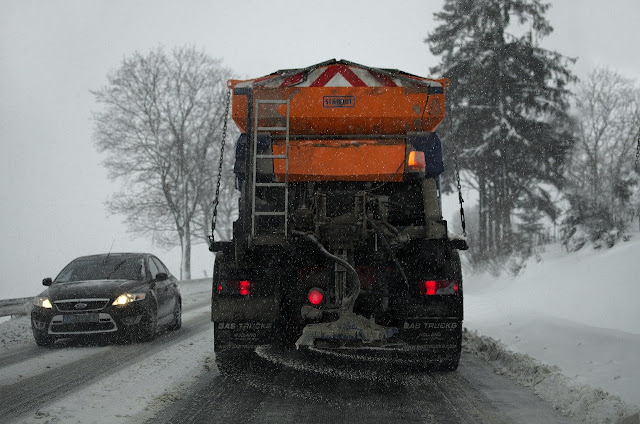
Truck is placing salt on icy road

In liquid water, molecules (made up of two hydrogen atoms and one oxygen atom - H2O) are free to move relative to each other. 

When the temperature drops below 0 °, these movements slow down until they stop. The water molecules then bind together in a sufficiently durable manner, symmetrically, freezing in the form of ice, solid water.

If the cooling process is slow, magnificent ice crystals are created, as the bonds between individual molecules have time to form very symmetrically on a large scale.

Now let's analyze the kitchen salt (sodium chloride). When trucks put salt on icy roads, the salt molecules break down into their sodium and chloride ions, just like when you put kitchen salt in a glass of water. Due to their proximity, these ions locally disturb the arrangement of water molecules.

The process then propagates deep into the rest of the ice, and slowly, solid water turns into liquid and salty water. 

You might think that when the ice melts with the help of salt, the temperature rises above 0°, but actually, the contrary happens.

If pure, water freezes at 0°C, and changes from liquid to a solid-state. If water is impure, its melting point drops below 0°C. Depending on the nature of the impurities and their quantity, the melting point is different. The salt spread on the roads is capable of lowering the melting temperature of the water, depending on the amount that is added. The more salt is added, the more the melting point drops below zero.

But when temperatures drop very low, table salt is no longer effective enough to melt ice. Other salts can be used, but they are more aggressive for the environment.

To melt ice on the roads, cooking salt can be replaced by another type of salt (eg. calcium chloride or magnesium chloride); where the same dissolution process is observed. But the result is a little different since one molecule of calcium chloride or magnesium chloride produces two chloride ions for one calcium or magnesium ion. In this case, the presence of a greater number of ions makes it possible to accelerate the melting of the ice.

Why do we have daylight savings time and when did it start?

As its name suggests, the purpose daylight savings time (changing the time) is to make better use of daylight and therefore save energy. Benjamin Franklin, one of America's founding fathers, mentions the time change in a letter from 1784 "The Cost of Light." Franklin humorously criticized the consumption of candles and suggested waking people up at sunrise to make better use of sunlight.

Drawing with clock and time change

For the first time, official daylight saving time was first introduced in Germany in 1916. In addition to saving raw materials, workers in the arms industry should be able to make better use of the days. After the end of the war, the government of the Weimar Republic abolished the time change. In the meantime, countries like France and Great Britain have also imposed daylight saving time on their populations. 

The National Socialists reintroduced daylight saving time to support the war economy from 1940 to 1945. In the postwar years with the division of Germany into occupation zones, things became even more complicated because in the West and the East, different times or summer times applied. The changeover was suspended again in 1950, until the oil crisis of the 1970s.

With a decision by the European Union, since 1996 uniform dates for the time change to summer time have been in effect throughout the European Union:

  • On the last Sunday in March, the clock is put forward one hour from 2 am to 3 am
  • On the last Sunday in October, the clock is set back from 3 am to 2 am

Effects of summer and winter time

The assumption that the clock change could have a positive effect on energy consumption has not been confirmed. Less electricity for lightning is actually used in the evenings during summer, but on the other side, more heating power is used in the morning in spring and autumn. 

Thus the increased consumption of heating energy compensates for the electricity saved. Also with the introduction of energy-saving lamps, time change has lost its original purpose.

Does daylight Savings affect mental health?

There are many research papers that warn about the massive effects of the time change. The time change affects the body like a little jet lag, from which people with sleep disorders and organic disorders suffer particularly. The reason for this lies in the disruption of the internal biological clock, which is disrupted by the time change. It also causes problems for domestic animals, especially those raised on farms. For example, by changing the working hours of farmers, the biological clock of breeding animals, such as cows, or sheep’s is disturbed, and certain period of adjustment is needed.


6 reasons why do cats hate water

Domestic cats have a strong aversion to water. The main reason for this is their fur. Cats can instinctively swim and actually pretty well. If a cat accidentally falls into the water, it will swim straight to the nearest solid surface after a quick orientation.

An old Chinese proverb says "All cats love fish but fear to wet their paws". 

Even before cats became pets, bathing or swimming in nature was not a behavior that was beneficial for cats. On the contrary: wet fur even gives cats several disadvantages.

Cat in front of pool


Photo: Pixabay.com

1 - Cats use their sense of smell to orientate themselves strongly. A wet fur disturbs this and so restricts the orientation.

2 - Cats protect their fur from water. If their thick fur gets wet, the weight increases, which means that the cat is severely disturbed in its balance and flexibility and that it is hindered in the event of a possible escape from danger.

3 - Cats are very clean animals and spend several hours a day grooming their fur. If the fur gets wet, the hygiene is over.

4 - Their fur protects them from the cold. A wet fur, on the other hand, loses its insulating effect and thus also the protection against the cold. Due to the high density of hair, the fur also takes a long time to dry.

Cats drinking water

5 - Cats lose their scent through water. Thanks to intensive grooming, cats get their very own personal scent, which other cats can also perceive from a distance. Once the fur has gotten wet, it takes a long time for its own scent to restore itself.

6 - There is also the shock factor. For example, accidentally falling into a full bathtub can be a frightening experience for a cat and they may fear water for the rest of their life.

Three cats in front of sea

Do all domestic cats hate water?

An aversion to water is one of the most well-known traits of domestic cats. However, this does not apply to all cats. Certain breeds of domesticated cats, such as the Maine Coon, Bengal, and Turkish Van, are less afraid of water and occasionally swim. What makes these breeds unique is the texture of their fur, which makes them more water resistant than other breeds.


Why Are Some Eggs Brown and Others White? The Science Behind Eggshell Color

Why are some chicken eggs brown while others are white? Does it depend on the chicken’s breed, its diet, or even the color of its feathers? Although brown and white eggs may look quite different on the outside, the reason for their color is surprisingly straightforward: genetics and pigments produced by the hen.

All chicken eggshells are made primarily of calcium carbonate, a naturally white mineral. White is therefore the basic color of an eggshell. Brown eggs become brown because certain pigments are deposited onto the shell during the final stages of egg formation.

But there is more to the story. Eggshell color is determined largely by the chicken’s genetics, and the color of the hen itself isn't always a reliable clue. Diet, meanwhile, can affect the color of the yolk, but generally does not determine whether an eggshell is brown or white.

So, are brown eggs healthier than white eggs? And do they taste different?

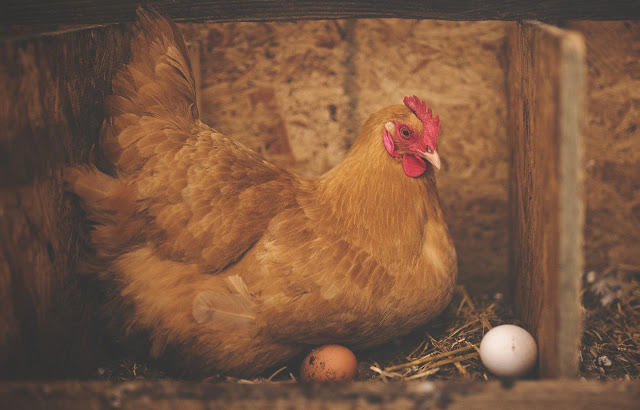
Chicken laying eggs. Brown under it, and white next to the chicken

Photo: Pixabey...

What determines the color of a chicken egg?

The color of a chicken’s eggshell is primarily genetically determined. Different breeds of chickens have different genes that control whether pigments are added to the developing eggshell.

Some breeds produce eggs with little or no shell pigment, resulting in white eggs. Other breeds produce pigments that give the shell shades ranging from light tan to deep brown.

This means that egg color is a characteristic of the chicken breed, rather than something caused by the chicken's diet.

It is also a common misconception that a chicken's feather color determines the color of its eggs. Although certain breeds may have a typical combination of feather and eggshell colors, the two traits are not directly linked. A brown or reddish chicken can lay white eggs, while some chickens with lighter feathers can lay colored eggs.

Why are brown eggs brown?

Brown eggshells contain pigments that are deposited on the shell while the egg is being formed inside the hen.

One of the important pigments involved is protoporphyrin IX, which is related to the breakdown of hemoglobin. Depending on the breed and the concentration of pigments produced by the hen, the eggshell can develop different shades of brown.

The intensity of the color can vary considerably. Some eggs may be pale cream or tan, while others can be a much deeper reddish-brown.

The pigment is primarily deposited on the outside of the shell, which is why the inside of a brown egg can look much whiter than its exterior.

When does an egg get its color?

An egg takes roughly a day to form inside a hen. Most of the egg's development occurs before the final stage when the shell receives its characteristic pigmentation.

The shell itself is formed mainly from calcium carbonate. Near the end of the process, pigment is deposited onto the shell in breeds that produce colored eggs.

This explains why an egg can spend much of its development without its final color and acquire its recognizable brown coloration relatively late in the process.

Why do some chickens lay white eggs?

White eggs are produced by chicken breeds that do not deposit significant amounts of pigment onto the eggshell.

The eggshell is naturally white because its primary mineral component, calcium carbonate, is white. When little or no pigment is added during shell formation, the egg remains white.

So, in simple terms:

  • White eggs: little or no pigment is deposited on the shell.
  • Brown eggs: pigments are deposited onto the shell.
  • Different shades: the amount and type of pigment can vary between breeds and individual hens.

Does a chicken's diet determine egg color?

No, not usually. A chicken's diet can have a noticeable effect on the color of the egg yolk, but it does not normally determine whether the shell will be brown or white.

For example, feed containing ingredients rich in natural pigments, such as corn or certain plants, can contribute to a deeper yellow or orange yolk.

This is why yolks can vary from pale yellow to a much richer orange color.

However, changing a hen's feed does not normally turn a white-shelled egg brown or a brown-shelled egg white. The shell color is primarily controlled by the hen's genetics.

Does the color of the chicken tell you what color egg it will lay?

Not necessarily.

Many people assume that brown or reddish chickens lay brown eggs and white chickens lay white eggs. While this can sometimes be a useful general rule for particular breeds, it is not a universal rule.

The genes responsible for feather color and those responsible for eggshell color are different. As a result, chickens with similar appearances can lay eggs of different colors.

The most reliable way to know what color eggs a particular chicken will produce is to know its breed or observe the eggs it lays.

Are brown eggs healthier than white eggs?

No. Brown eggs are not automatically healthier than white eggs.

Because many organic or premium eggs sold in supermarkets are brown, consumers sometimes assume that the darker shell means the egg contains more vitamins, minerals, or other nutrients.

This is largely a misconception.

The color of the eggshell itself does not determine the nutritional value of the egg. Brown and white eggs can have very similar nutritional profiles when they come from hens raised under comparable conditions and given comparable diets.

Factors such as the hen's diet, age, living conditions, and overall health can be much more relevant to the nutritional characteristics of an egg than the color of its shell.

Do brown eggs taste different from white eggs?

There is no inherent reason for a brown egg to taste different simply because its shell is brown.

If you notice differences in taste between eggs, they are more likely to be related to factors such as:

  • the hen's diet;
  • freshness;
  • how the hens were raised;
  • storage conditions; and
  • how the eggs are cooked.

Shell color itself is not a reliable indicator of flavor.

Are brown eggs more expensive?

Brown eggs are sometimes more expensive than white eggs, but this is not because brown eggs are inherently better or more nutritious.

The price difference can be influenced by the breed of chicken used, production costs, farming practices, marketing, and consumer demand.

In some markets, brown eggs are associated with free-range, organic, or premium products, which can contribute to a higher price. But the shell color alone does not make an egg nutritionally superior.

Are brown eggshells stronger than white eggshells?

Eggshell strength is influenced by several factors, including the hen's breed, age, nutrition, and the structure and thickness of the shell.

Brown eggs are sometimes perceived as having thicker or harder shells. However, shell color itself is not what determines strength.

A brown egg and a white egg can both have strong or fragile shells depending on the characteristics of the hen that produced them.

Frequently Asked Questions

Why are some eggs brown and others white?
The main reason is genetics. Different chicken breeds produce different eggshell pigments. White eggs have little or no pigment, while brown eggs receive pigments during shell formation.

Does a chicken's diet determine whether its eggs are brown or white?
Generally, no. Diet can influence the color of the yolk, but eggshell color is primarily determined by genetics.

Are brown eggs healthier than white eggs?
Not necessarily. Brown eggs are not inherently more nutritious than white eggs. Nutritional differences are more closely related to factors such as the hen's diet and production conditions.

Do brown eggs taste better?
Not because of their color. Taste can be affected by freshness, diet, storage, and cooking, but shell color itself does not make an egg taste better.

Do white chickens always lay white eggs?
No. Feather color does not reliably determine eggshell color. Different genetic traits control these characteristics.

Why are brown eggs sometimes more expensive?
Price can be influenced by breed, production costs, farming practices, marketing, and consumer demand. Brown shell color itself does not make an egg more nutritious.

Read more:

Don't miss:

Why is the ozone layer important in sustaining life on Earth?

The ozone layer blocks a large part of the sun's rays and prevents too much ultraviolet radiation from reaching the earth. This is vital, because the high-energy ultraviolet rays of the sun can destroy the cells of animals and plants and damage human skin. If the ozone layer in the stratosphere is intact, it acts like a huge protective screen against aggressive UV radiation.

Ozone Hole

The ozone layer in the atmosphere protects the earth's surface from dangerous radiation. However, this protective shield is endangered by chemical compounds, especially CFCs from refrigerators and spray cans.


Sunlight and Ultraviolet (UV) Radiation 

Sunlight is essential for human health because, among other things, it regulates the daily and annual rhythm and helps supply the body with vitamin D. 

However, if you expose your body to excessive solar radiation, damage to health, which is mainly caused by the shorter wavelength ranges, can occur. These include skin cancer, skin aging, eye diseases and the weakening of the immune system. 

Electromagnetic spectrum

The skin protects itself from UV radiation by storing the complex molecule melanin. With longer and more intensive radiation, the skin becomes reddened by the high energy of UV-B radiation and sunburn occurs. As the disease progresses, severe burns and blistering occur and the tissue dies. As a result, more often Long exposure to UV radiation results in irreversible changes in the skin such as wrinkles and permanent vasodilatation. 

The most serious long-term consequence is skin cancer, which is caused by changes in the genetic make-up in the skin cells caused by UV-B. 

“

Ultraviolet radiation is divided into three wavelength ranges according to its biological effect. 

  • UV-A radiation  -  315–400 nm (UV-A radiation and visible light hit the earth's surface practically unfiltered)
  • UV-B radiation - 280-315 nm (more energetic, dangerous - Ozone and oxygen molecules absorb over 90 percent of the incident UV-B radiation)
  • UV-C radiation - 190–280 nm (Highly energetic radiation, completely absorbed by ozone and oxygen molecules in the stratosphere and therefore does not reach the earth's surface). 


How is ozone formed in the atmosphere?

Ozone is a natural component of the earth's atmosphere, but only occurs in very low concentrations. Near the ground it reaches a proportion of around 30 molecules in one billion air molecules. However, the ozone concentration in the stratosphere increases significantly with altitude. The maximum of the ozone layer is measured in the middle stratosphere in an altitude range between 15 and 30 kilometers, where the mixing ratio of ozone to air can be 300 times the value close to the ground.

Stratospheric ozone is formed naturally in photochemical reactions with the participation of molecular oxygen and ultraviolet solar radiation.

Photochemical ozone production is most effective where the sun shines longest and most intensely, in the tropics and subtropics. From there the ozone is transported with the large-scale circulation to higher geographical latitudes.

The ozone is formed in the stratosphere from molecular oxygen in two steps: In the first step, diatomic oxygen molecules O2 are split into two oxygen atoms each by the sun's UV radiation.  These are very reactive. In the second step, these oxygen atoms react with oxygen molecules to form three-atom ozone O3. The energy released in the process has to be absorbed by a third reaction partner (usually nitrogen or oxygen) by collision.

The stratospheric ozone not only represents an effective UV-B protective shield, but also releases the absorbed solar energy in the form of heat to the surrounding atmosphere. In this way, ozone significantly determines the vertical temperature structure of the stratosphere and thus also shapes the large-scale air currents.

What is causing the ozone hole?

If the ozone layer didn't exist, the sun's rays would literally roast us on the ground. Life in its current form would not be possible at all without this protective screen.

But the ozone layer has dangerously large holes. The reason for this are chemical substances that humans have blown into the atmosphere. The greatest enemy of ozone is chlorofluorocarbons, or CFCs. For a long time this gas was used as a coolant in refrigerators and as a propellant in spray cans. Itself odorless and non-toxic, CFCs are only dangerous to humans when they rise in the stratosphere, reacting with ozone, thus attacking and destroying the ozone layer.

Because of their inertia, they were considered harmless substances for a long time. In fact, CFCs do not pose a threat in the troposphere, but because of their extreme longevity, they can slowly make their way into the stratosphere above. In the stratosphere, the higher intensity of high-energy UV radiation then breaks down the CFC molecules. The chlorine released in this way then acts as a catalyst in destroying the ozone molecules.

Who discovered the ozone hole?

In 1985 a research team led by the British geophysicist Joseph Charles Farman, documented a drastic and progressive decrease in the ozone layer of up to 60 percent over the Antarctic. This phenomenon is known as the ozone hole and resulted with serious international negotiations on the issue of emission control.

Strong chemical ozone depletion is also observed in the arctic polar regions in spring. The ozone losses there are typically 20-25 percent, but can sometimes increase to up to 60 percent if the stratospheric temperatures are extremely low. Lesser but significant stratospheric ozone depletion is observed today over numerous other, also more densely populated areas of the earth.

What is being done to repair the ozone layer?

To protect the ozone layer, the Montreal Protocol was passed in 1987, an international agreement that came into force in 1989 and with which the signatory states committed themselves to a gradual reduction and finally to the complete abolition of the emission of chemicals containing chlorine and bromine that destroy stratospheric ozone. 


The ozone-depleting substances are increasingly being replaced by fluorocarbons (PFCs). Although these HFCs protect the ozone layer, they are not climate-friendly. Depending on their structure, they contribute to global warming for each amount of gas introduced than the most important greenhouse gas carbon dioxide (CO2). 

Photo: NASA.gov...

The increasing warming of the troposphere simultaneously leads to a decrease in temperature in the stratosphere, which in turn accelerates the chemical ozone depletion. In addition to nitrous oxide, methane and, of course, carbon dioxide, PFCs are among the emissions that are to be monitored for climate protection under the Kyoto Protocol.

Since many processes, such as the connection between climate change and ozone depletion, are still largely not understood, it is difficult for scientists to make reliable predictions for the future of ozone depletion or build-up.


Why is the Black Sea called the Black Sea

The ancient Greeks were the first to name the Black Sea, and they called it "Inhospitable Sea", since the sea was difficult to navigate, and also at the time, hostile tribes inhabited its shores. With the settlement of Greek colonists at the shore of the sea, its name became “Eύξεινος Πόντος”, or "Hospitable Sea". This name is still used in some Greek sources, but also the name “Μαύρη Θάλασσα” or "Black Sea" is common in many sources.

Black Sea Bulgaria

Photo: Pixabey...

It has not been established exactly to which of the explanations the name of the Black Sea can be traced back, but is certain that the name comes from the Turkish vocabulary. 

When Anatolia was conquered by the Ottomans, they kept the names used by the Genoese and Venetians. They called the Black Sea the "Mare Maggiore", or the "Great Sea".

"Mare Maggiore" translated into the language of the Ottomans, means "KaraDeniz". Deniz stands for sea. The word Kara in Turkish has several meanings, like big, dark, and cloudy. Over the years the meaning of the word "kara" changed into the word "dark" or Black, and Slavic people like the Bulgarians and Russians kept this expression.

But why the sea is called - Black

The water of the Black Sea is so opaque that it is almost impossible to see through more than 2 feet (60 cm) of the upper water layer. The sea is more than 150 meters deep and its water is filled with hydrogen sulphide, therefore, there are no living beings in the deepest layers of its water, except for sulphur bacteria. Metal objects from ships, dead plants and animal matter that had sunk over 150 meters deep for a long time were covered in black mud due to the high concentration of hydrogen sulphide in the sea.

From the point of view of seafarers, the sea has been black due to severe winter storms which make the water so dark it looks black.

What other names are used for the Black Sea?

Current names of the sea are usually equivalents of the English name "Black Sea", including these given in the countries bordering the sea: (Wikipedia.org...)

  • Abkhazian: Амшын Еиқәа, romanized: Amʂən Eikʰʷa
  • Adyghe: Хы шӏуцӏэ, romanized: Xı ṩʔutsʔə
  • Armenian: Սեւ ծով, romanized: Sev tsov
  • Bulgarian: Черно море, romanized: Cherno more
  • Crimean Tatar: Къара денъиз, romanized: Qara deñiz
  • Georgian: შავი ზღვა, shavi zghva
  • Laz and Mingrelian: უჩა ზუღა, romanized: Ucha Zugha, IPA: [utʃɑ zuɣɑ], or simply ზუღა
  • Romanian: Marea Neagră, pronounced [ˈmare̯a ˈne̯aɡrə]
  • Russian: Чёрное мо́рe, romanized: Chyornoye more
  • Turkish: Karadeniz
  • Ukrainian: Чорне море, romanized: Chorne more


Why is a day on earth 24 hours long?

The day lasts 24 hours just because people wanted to share it like this. There is nothing in nature about hours, minutes and seconds. This division of time was made by man according to his wish.
But there is something in nature that happens in one day. Each time the Earth rotates once about its axis, a certain time passes, which we call a day. Using stars, scientists can accurately measure time. In observatories, a day begins when a star crosses the meridian and lasts until it crosses it again.

Since man divided the day into hours, minutes and seconds, we can say exactly how long a day lasts: 23 hours, 56 minutes, and 4.09 seconds. This is called a sidereal day. But since it would be difficult to use sidereal day in practical life, we take the day to last 24 hours, so we add a leap year to correct the difference.

Why is a day on earth 24 hours long? Image by Gerd Altmann from Pixabay

In the old days, people thought that the day lasted from sunrise to sunset. The duration of the night was not counted. The Greeks reckoned that the day lasted from sunset to sunset and the Romans from midnight to midnight.
While the clocks had not yet been discovered, it was calculated that day and night lasted 12 hours each. Such a division was not practical, as the length of day and night varied between seasons. Today in most countries, the law stipulates that the day lasts 24 hours, from midnight to midnight, according to Roman times.

How long does it take for a bee to die after stinging?

After stinging the honeybees cannot retract their stinger, so they die soon after. These bees are no more desirable in the nest and other bees are not friendly to them.

How long does it take for a bee to die after stinging?

In an experiment with five bees, which were placed in a cage and returned to the hive after stinging, it was found that they lived for 6, 38, 96 and 102 hours, receiving food through the cage, with whom they were protected. Usually, bee’s guts come out with the stinger, and that’s why some of them die faster than others.

Thus, it is recommended for people who practice Bee Venom Therapy to kill the bee right away after it stings, to end its suffering. 

If a bee stings another bee, the other dies immediately.

What is a Peacock a symbol of?

Peacock Bird is a symbol of resurrection, renewal, and immortality.

Peacocks are a species of birds that include two Asiatic species (the blue and the green peafowl) and one African.

Peacock Bird - symbol of resurrection, renewal, and immortality.

The term peacock is properly reserved for the male; the female is known as a peahen, and the immature offspring are sometimes called peachicks.

In Christianity, the Peacock symbolism represents the "all-seeing" church, along with the holiness and sanctity associated with it.

Additionally, the Peacock represents resurrection, renewal, and immortality within the spiritual teachings of Christianity.

Peacock Bird in Monastery Saint Naum on Ohrid Lake

Peacock Bird in Monastery Saint Naum on Ohrid Lake, Macedonia 

Peacock Bird in Monastery Saint Naum on Ohrid Lake
Peacock Bird in Monastery Saint Naum on Ohrid Lake, Macedonia

Peacock Bird in Monastery Saint Naum on Ohrid Lake
Peacock Bird in Monastery Saint Naum on Ohrid Lake, Macedonia

They will welcome you with their screams, which can be heard far away,  and if you are lucky you will have a chance to enjoy the scene of their beautiful colored feathers.

What is the function of a lever and Examples of a levers?

The lever is the most wonderful mechanical element in the world. The expression, lever, is not employed in the sense of a stick or a bar which is used against a fulcrum to lift or push something with, but as the type of numerous devices which employ the same principle.

Excerpt from the book: Practical Mechanics for Boys / Author: J. S. Zerbe

Some of these devices are, the wedge, the screw, the pulley and the inclined plane. In some form or other, one or more of these are used in every piece of mechanism in the world.

Because the lever enables the user to raise or move an object hundreds of times heavier than is possible without it, has led thousands of people to misunderstand its meaning, because it has the appearance, to the ignorant, of being able to manufacture power.

Wrong Inferences from Use of Lever


This lack of knowledge of first principles, has bred and is now breeding, so-called perpetual motion inventors (?) all over the civilized world. It is surprising how many men, to say nothing of boys, actually believe that power can be made without the expenditure of something which equalizes it

The boy should not be led astray in this particular, and I shall try to make the matter plain by using the simple lever to illustrate the fact that whenever power is exerted some form of energy is expended.

In Fig. 1 is a lever (A), resting on a fulcrum (B), the fulcrum being so placed that the lever is four times longer on one side than on the other. A weight (C) of 4 pounds is placed on the short end, and a 1-pound weight (D), called the power, on the short end. It will thus be seen that the lever is balanced by the two weights, or that the weight and the power are equal.
Simple Lever
Fig. 1. Simple Lever

The Lever Principle

Now, without stopping to inquire, the boy will say: "Certainly, I can understand that. As the lever is four times longer on one side of the fulcrum than on the other side, it requires only one-fourth of the weight to balance the four pounds.
But suppose I push down the lever, at the point where the weight (D) is, then, for every pound I push down I can raise four pounds at C.
In that case do I not produce four times the power?"

I answer, yes.
But while I produce that power I am losing something which is equal to the power gained.

What is that?

Lever Action
Fig. 2. Lever Action

First: Look at Fig. 2; the distance traveled. The long end of the lever is at its highest point, which is A; and the short end of the lever is at its lowest point C. When the long end of the lever is pushed down, so it is at B, it moves four times farther than the short end moves upwardly, as the distance from C to D is just one-fourth that from A to B. The energy expended in moving four times the distance balances the power gained.

Power vs. Distance Traveled

From this the following law is deduced: That whatever is gained in power is lost in the distance traveled

Second: Using the same figure, supposing it was necessary to raise the short end of the lever, from C to D, in one second of time. In that case the hand pressing down the long end of the lever, would go from A to B in one second of time; or it would go four times as far as the short end, in the same time.

Power vs. Loss in Time

This means another law: That what is gained in power is lost in time.

Distinguish clearly between these two motions. In the first case the long end of the lever is moved down from A to B in four seconds, and it had to travel four times the distance that the short end moves in going from C to D.

In the second case the long end is moved down, from A to B, in one second of time, and it had to go that distance in one-fourth of the time, so that four times as much energy was expended in the same time to raise the short end from C to D.

Wrongly Directed Energy

More men have gone astray on the simple question of the power of the lever than on any other subject in mechanics. The writer has known instances where men knew the principles involved in the lever, who would still insist on trying to work out mechanical devices in which pulleys and gearing were involved, without seeming to understand that those mechanical devices are absolutely the same in principle.

This will be made plain by a few illustrations. In Fig. 3, A is a pulley four times larger, diametrically, than B, and C is the pivot on which they turn. The pulleys are, of course, secured to each other. In this case we have the two weights, one of four pounds on the belt, which is on the small pulley (B), and a one-pound weight on the belt from the large pulley (A).

Fig 3 - The Pulley

The Lever and the Pulley

If we should substitute a lever (D) for the pulleys, the similarity to the lever (Fig. 2) would be apparent at once. The pivot (C) in this case would act the same as the pivot (C) in the lever illustration.

In the same manner, and for like reasons, the wedge, the screw and the incline plane, are different structural applications of the principles set forth in the lever.

Whenever two gears are connected together, the lever principle is used, whether they are the same in size, diametrically, or not. If they are the same size then no change in power results; but instead, thereof, a change takes place in the direction of the motion.
Change of Direction
Fig 4 - Change of Direction


Change of Direction
Fig 5 - Change of Direction

When one end of the lever (A) goes down, the other end goes up, as shown in Fig. 4; and in Fig. 5, when the shaft (C) of one wheel turns in one direction, the shaft of the other wheel turns in the opposite direction.

It is plain that a gear, like a lever, may change direction as well as increase or decrease power. It is the thorough knowledge of these facts, and their application, which enables man to make the wonderful machinery we see on every hand.

Contour Plowing: What Is and How Does It Prevent Soil Erosion?

What is contour plowing? Contour plowing is a farming method used to reduce soil erosion on sloping land. Instead of plowing straight up and down a hill, farmers plow across the slope, following the natural contours of the land.

This simple technique helps slow the movement of rainwater. Rather than rushing downhill and carrying valuable topsoil with it, water is held by the furrows created by the plow. It can then gradually soak into the soil.

Contour plowing is an important soil conservation practice because healthy, fertile soil is essential for growing food. If farmland is carefully managed, it can remain productive for generations.

Contour Plowing: What Is and How Does It Prevent Soil Erosion?

Contour plowing is the practice of plowing and planting crops along the natural contour lines of a slope.

On sloping farmland, water naturally tends to flow downhill. If a field is plowed in straight rows running from the top of the hill to the bottom, these rows can create channels through which rainwater quickly travels.

Fast-moving water can carry loose soil downhill. Over time, this process, known as water erosion, can remove fertile topsoil from agricultural fields.

Contour plowing changes the direction of those furrows. Instead of creating long downhill channels, the furrows run across the slope. They act as small barriers that interrupt the movement of water and encourage it to infiltrate the soil.

Why Is Contour Plowing Important?

The top layer of soil, known as topsoil, is especially valuable for agriculture. It contains organic matter, nutrients, microorganisms, and other materials needed for healthy plant growth.

When heavy rain washes topsoil away, farmers can lose some of the most productive part of their land.

Soil erosion can cause several problems:

  • Loss of fertile topsoil
  • Reduced agricultural productivity
  • Loss of soil nutrients
  • Increased runoff
  • Sediment entering streams and rivers
  • Greater risk of flooding in some areas
  • Degradation of agricultural land

Contour plowing helps address some of these problems by slowing water movement across a field.

How Does Contour Plowing Work?

Imagine a farmer standing on a hillside during heavy rain.

If the field has been plowed up and down the slope, rainwater can follow the furrows downhill. As the water gains speed, it can loosen and carry soil particles with it.

Now imagine the same field plowed across the slope.

The furrows run roughly parallel to the contours of the hillside. When rain falls, the furrows interrupt the downhill movement of water. Instead of immediately running toward the bottom of the hill, some water collects in the small depressions and has more time to soak into the ground.

In this way, contour plowing can reduce the speed and erosive power of surface runoff.

What Is Water Erosion?

Water erosion occurs when moving water removes and transports soil particles.

Rainfall can cause erosion in several ways. When raindrops strike exposed soil, they can break apart soil aggregates and loosen particles. Water flowing across the surface can then carry those particles downhill.

On steep or poorly managed farmland, erosion can become particularly serious.

The process can gradually remove the upper layer of soil and transport sediment into drainage channels, streams, and rivers.

Because topsoil forms very slowly compared with the speed at which it can be lost through erosion, preventing unnecessary soil loss is an important part of sustainable agriculture.

Contour Plowing vs. Plowing Up and Down a Slope

The direction in which a field is plowed can make a significant difference on sloping land.

Plowing up and down the slope

When furrows run directly downhill, they can provide pathways for water to move quickly toward lower areas.

During heavy rainfall, this can increase runoff and soil loss.

Contour plowing

When furrows follow the contours of the slope, they interrupt the downhill flow of water.

The result can be:

  • Slower surface runoff
  • Greater water infiltration
  • Less soil being carried downhill
  • Better retention of topsoil
  • Reduced sediment movement

Contour plowing does not eliminate erosion entirely, but it can be an effective way to reduce it when appropriately applied.

How Does Contour Plowing Prevent Soil Erosion?

The key to contour plowing is slowing water down.

Water moving rapidly over exposed soil has greater ability to transport soil particles. By creating furrows that run across the slope, farmers can interrupt the continuous downhill flow.

The furrows can temporarily hold some rainwater. This gives the water more opportunity to infiltrate into the ground rather than immediately flowing downhill.

The soil therefore has a better chance of staying where it belongs.

This is especially important during periods of heavy rainfall when large amounts of water can move across a field in a short time.

Benefits of Contour Plowing

Contour plowing can provide several environmental and agricultural benefits.

1. Reduces soil erosion

The most important benefit is reducing the amount of soil carried away by surface runoff.

Keeping topsoil in the field helps preserve the land's productive capacity.

2. Conserves water

Because the furrows slow runoff, more rainwater may have an opportunity to infiltrate into the soil.

This can make better use of rainfall and reduce the amount of water immediately leaving the field.

3. Protects fertile topsoil

Topsoil contains many of the nutrients and organic materials needed by crops. Reducing erosion helps farmers retain this valuable resource.

4. Reduces sediment in waterways

Soil washed from agricultural fields can eventually enter streams, rivers, ponds, and reservoirs.

By reducing runoff and erosion, contour plowing can help decrease the amount of sediment reaching nearby waterways.

5. Can reduce downstream flooding problems

When large quantities of runoff and sediment leave agricultural fields, they can contribute to problems downstream. Keeping more water and soil within the field can help reduce these effects, although contour plowing alone cannot prevent flooding.

6. Supports sustainable agriculture

Contour plowing is a relatively simple conservation practice that works with the natural shape of the landscape rather than ignoring it.

Does Contour Plowing Work on Every Farm?

No. Contour plowing is particularly suited to sloping agricultural land, but it is not equally appropriate for every field or every type of terrain.

The effectiveness of the technique depends on factors such as:

  • Slope steepness
  • Soil type
  • Rainfall intensity
  • Field size and shape
  • Crop type
  • Farming equipment
  • Drainage patterns
  • Local climate

On very steep slopes or areas exposed to intense rainfall, additional conservation methods may be needed.

Farmers may combine contour plowing with other practices such as terracing, strip cropping, cover crops, grassed waterways, and reduced tillage.

Contour Plowing and Sustainable Farming

Modern agriculture depends on maintaining the quality of the soil. Once fertile topsoil has been seriously degraded or lost, restoring it can take a very long time.

For this reason, soil conservation is an important part of sustainable farming.

Contour plowing represents a broader principle: farm the land according to its natural characteristics.

Rather than allowing rainfall to flow unchecked down a slope, farmers can use the shape of the landscape to slow runoff and keep soil where it is needed.

Combined with other conservation methods, this approach can help agricultural land remain productive over the long term.

Contour Plowing and Other Soil Conservation Methods

Contour plowing is only one method farmers can use to control erosion.

Terracing

Terraces divide steep slopes into a series of relatively level steps. They can greatly reduce the distance water travels downhill and are especially useful in some mountainous or steep agricultural areas.

Cover crops

Cover crops are plants grown to protect the soil between periods of production. Their roots can help hold soil together, while their vegetation protects the surface from rainfall.

Strip cropping

Strip cropping involves growing different crops in alternating strips, often arranged across a slope. The strips can help interrupt runoff and reduce erosion.

Mulching

Mulch covers the soil surface and can protect it from the direct impact of raindrops. Organic mulch can also contribute organic matter as it decomposes.

Reduced tillage

Reduced-tillage systems minimize soil disturbance. Leaving more plant residue on the surface can help protect soil from wind and water erosion.

What Happens If Farmland Is Not Protected?

When soil is repeatedly exposed to heavy rainfall without adequate conservation, erosion can gradually reduce the quality of farmland.

The effects may not always be obvious after a single storm. Soil loss can happen slowly over many years.

As fertile topsoil disappears, farmers may experience declining soil productivity. Nutrients and organic matter can be lost along with the soil particles.

The sediment does not simply disappear. It may be transported into ditches, streams, rivers, lakes, and reservoirs.

This is why preventing erosion is generally more effective than trying to restore severely eroded farmland later.

Frequently Asked Questions About Contour Plowing

What is contour plowing in simple terms?

Contour plowing means plowing across a hillside rather than straight up and down it. The furrows follow the natural contours of the land and help slow rainwater runoff.

What is the main purpose of contour plowing?

The main purpose is to reduce soil erosion caused by water. By slowing runoff, contour plowing helps prevent rainwater from carrying valuable topsoil downhill.

How does contour plowing conserve water?

The furrows created across the slope can slow surface runoff and give water more time to infiltrate into the soil.

Is contour plowing the same as terracing?

No. Contour plowing involves creating furrows that follow the contours of a slope. Terracing involves reshaping a slope into a series of stepped areas.

Does contour plowing completely stop soil erosion?

No. It can significantly reduce erosion under suitable conditions, but it does not eliminate all erosion. In areas with steep slopes or intense rainfall, additional conservation practices may be necessary.

Why is topsoil important?

Topsoil contains organic matter and nutrients that support plant growth. Losing large amounts of topsoil can reduce the productivity and long-term health of agricultural land.

Can contour plowing help prevent flooding?

It can reduce and slow surface runoff under appropriate conditions, which may help reduce the amount of water moving rapidly downhill. However, it is not a complete solution to flooding.

Read more:

HOW IS BIOGAS MADE?

Dead animals and plants rot and decay. In swampy areas, for example, dead plants fall into the water. As they decay, they give off - gas. 

Scientists call this biogas.

Biogas comes from garbage, sewage, and manure, too.

Biogas is a source of cheap energy for many villages in China. Many vehicles are fueled by methane, a mixture of biogas and carbon dioxide.

Biogas is a valuable source of energy that is often wasted. When materials decay, the biogas mixes with carbon dioxide, forming a gas called methane. Large amounts of methane can be dangerous—a tiny spark near the gas can cause an explosion. But if methane is collected safely and stored correctly, it can provide an important source of energy.

Drawing of biogas production facility at a farm

Biogas could be important in countries where other fuels are scarce or too expensive. A small village can use its own garbage and sewage to produce biogas. People collect the droppings of farm animals and put them in a tank. Some of the waste turns into liquid. 

The liquid soon starts to give off methane, which is kept in a storage tank that has an expandable lid. The gas can be used in homes for cooking and heating, or as fuel to power an engine or an electric generator.


Is biogas eco-friendly fuel?

Compared to natural gas, which is extracted by drilling in the ground, biogas is obviously a more sustainable option. Natural gas is obtained through fracking, a process in which water, chemicals, and sand are forced deep into the ground to break up rock formations. The fracking process can seriously damage ecosystems and landscapes. 

Another benefit of biogas is that it eliminates the large amounts of animal manure and food waste from the environment, and thus prevents nitrogen pollution and leakage into water resources. 

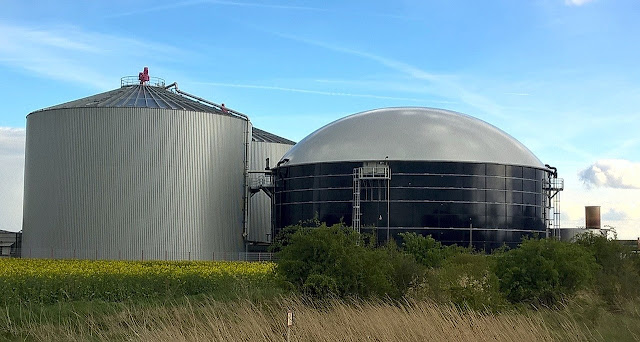
Biogas production facility


Biogas also helps reduce methane emissions that would otherwise escape from manure dumps or lagoons. Using this methane as a fuel drastically reduces its impact on the climate by converting it to CO2, which is up to 34 times less efficient than a greenhouse gas.

But in contrast to energy generation using wind power or solar energy, during biogas production, greenhouse gases are released into the atmosphere through the systems. Methane in particular can escape at various points in production. 

In addition, biogas also contains nitrogen, carbon dioxide, and nitrous oxide, among other things. The latter is only represented in small proportions but is even around 300 times as harmful as CO2. In addition, if the biogas from the plants is burned to generate energy, CO2 is produced in turn.

In addition, the transport of energy crops to the plants contributes to the negative balance of biogas.

What are the advantages of biogas?

The production of biogas brings important benefits for the environment and society :
1. Biogas is a green energy source, from which electricity and heat can be obtained.
2. Biogas is created through the fermentation of renewable raw materials, replaces fossil fuels and thus reduces greenhouse gas emissions.
3. The combustion of biogas only releases as much CO2 as the plants previously absorbed during growth. This means that biogas is one of the CO2-neutral fuels.
4. Unlike wind, water or solar energy, biogas is available without fluctuations and can be stored without any problems.
5. With biogas, organic waste from industry and households is recycled in an environmentally friendly manner.
6. Less odor nuisance when spreading liquid manure in the fields: fermented liquid manure smells considerably less than normal liquid manure and the smell wears off faster.
7. Plants absorb the fermentation substrate better than normal manure, which can increase the yield in the fields.
8. The cost of artificial fertilizers can be reduced and environmental pollution avoided.

What is Air Made of and How gases are separated from the Air?

What is the Composition of Air?

Composition of Air for Kids - What is Air Made of?

About one-fifth of the air is oxygen.   

Human beings and other animals would not be able to survive without oxygen.

When we breathe, our lungs take the oxygen we need from the air.

Another very important gas in the air is carbon dioxide.

When we breathe out, we release carbon dioxide into the air. 
In daylight, plants take in the carbon dioxide they need to live and grow, and they make oxygen.

They then release the oxygen back into the air.

About four-fifths of the air is nitrogen. 

We breathe in nitrogen, but we don't use it.

There are also small amounts of other gases in the air.

Argon is one of these.

We breathe in argon but, like nitrogen, we don't use it.

The air also contains tiny amounts of water vapor.


Green plants take in carbon dioxide from the air. Plants use carbon dioxide and water to make glucose, a type of sugar used for food energy.

Green plants take in carbon dioxide from the air. Plants use carbon dioxide and water to make glucose, a type of sugar used for food energy. 
In the process, plants give out oxygen through their leaves.
It isn't just living things that use oxygen in the air. 
A flame needs oxygen to burn. 

There's no oxygen in outer space, so you can't light a match there.
Oxygen mixes with other substances too, and it sometimes changes them. Oxygen and water make iron turn to rust. As the iron rusts, it uses up oxygen in the air.


Rusting process experiment - The rusting process needs oxygen

You will need:
  • soap 
  • water
  • a shallow dish 
  • a felt-tipped pen 
  • a nail or large pin 
  • a ball of steel wool 
  • a plastic cup 
  • a large glass jar

1. Wash the steel wool in soapy water to remove any grease.
2. Pour about 1 inch (2.5 centimeters) of water into the dish.


3. Use the nail or pin to prick the plastic cup in several places. Place the cup upside down in the water.


4. Place the steel wool on top of the cup. Put the jar over the steel wool and the cup. Mark the water level on the side of the jar.


5. Leave your experiment for a few days. Add more water if necessary. Now and then. gently rock the jar to allow more water underneath. Be careful not to let in more air.

As time goes on. the steel wool will begin to rust. 
The rusting process uses up oxygen. As the air is used, the water level in the jar will rise to fill the space. 
Eventually, all the oxygen will have been used up and the water will take up about one-fifth of the air space in the jar.


Can we see the air?

If you go out on a windy day, you can feel the wind tugging at your body, hair, and clothes.
You can see the trees and flowers bending and the clouds racing across the sky.

Perhaps an old newspaper is blown along the road, or the smoke from a chimney is blowing out sideways instead of going straight up.

What is doing all this pushing and shoving?

What is moving everything about?

It is air.

Can we see air - experiment


Air is a mixture of many different gases. 
These different gases are very useful.
But they must be separated from each other before we can use them.

How gases are separated from the air?

Air is first changed from a gas to a liquid.

It is compressed, which means it is squeezed into a smaller space, and then cooled to about - 310 °F (-190 °C).

Then the liquid air passes into a tower called a fractionating column. 

The tower is warmer at the bottom and cooler at the top.

The liquid begins to evaporate, turning into gas.

Some gases evaporate at a lower temperature.

Helium and neon collect at the top of the tower.

Nitrogen evaporates next, leaving liquid oxygen at the bottom of the tower.

Separating gases in this way is called fractional distillation.


Gases from the air are used in many different ways.

People with breathing problems cannot take in enough oxygen. They are given special air with extra oxygen added to it.

Fuels cannot burn without oxygen.

A gas called acetylene burns in pure oxygen to give a very hot flame. The flame can melt metals and cut through them.

In sewage plants, oxygen is used to help change harmful substances into harmless ones.

Liquid nitrogen is very cold and is used to freeze foods quickly. It can also freeze liquids in damaged pipes so that the pipes can be repaired.

Substances do not burn in nitrogen, so it is also used inside light bulbs to keep the filament from burning away. In oil tankers, it can prevent fires and explosions.

Plants need nitrogen, so many farmers put fertilizers containing nitrogen compounds into the soil.

What is Radioactivity and Why is it dangerous?


The world is changing around us all the time.
There are physical changes as matter changes from solid to liquid to gas.
When water evaporates, the water molecules stay the same but move farther apart.
There are chemical changes, too, such as iron rusting.

When iron atoms combine with oxygen atoms and water, they react together to become a different substance.

There is another way in which matter changes.
Matter can go through a nuclear change.

When a nuclear change happens, the nucleus of the atom sends out invisible rays.
Substances that contain this type of atom are called radioactive substances.
Matter contains some radioactive atoms.
They can be both harmful and useful.

Radioactive atoms have large amounts of energy, which is given out as rays.

How strong is radioactivity?

There are three main kinds of radioactive rays. 
  • A beam of alpha particles is not strong enough to pass through two pieces of strong paper. 
  • A beam of beta particles can pass through paper but can be blocked by a thin sheet of aluminum. 
  • Gamma rays can pass through a concrete wall, Only a thick layer of lead can stop the path of a gamma-ray.
What is Radioactivity and Why is it dangerous?

What is radioactivity used for?

A gamma-rays can be used to check metal pipes and machine parts for cracks. A photograph is taken as the ray passes through the metal.

A beam of beta particles can be used to check if packages are full or empty. If the package is empty, the beam will pass all the way through it.

Materials contain small amounts of radioactive atoms.

In time, these atoms gradually change into different kinds of substances and the radioactivity decays. 

Scientists can measure the age of rocks and fossils, bones, and even ancient cloth by measuring the amount of radioactivity left in the material.
This is called radiocarbon dating.

Although radioactivity can be very useful, it can also be very dangerous.
If people are exposed to too much radiation, they become ill or die. So radioactive substances must be handled very carefully. People who work in nuclear power stations wear special clothes to protect them from radiation.