Why do we have daylight savings time and when did it start?

As its name suggests, the purpose daylight savings time (changing the time) is to make better use of daylight and therefore save energy. Benjamin Franklin, one of America's founding fathers, mentions the time change in a letter from 1784 "The Cost of Light." Franklin humorously criticized the consumption of candles and suggested waking people up at sunrise to make better use of sunlight.

Drawing with clock and time change

For the first time, official daylight saving time was first introduced in Germany in 1916. In addition to saving raw materials, workers in the arms industry should be able to make better use of the days. After the end of the war, the government of the Weimar Republic abolished the time change. In the meantime, countries like France and Great Britain have also imposed daylight saving time on their populations. 

The National Socialists reintroduced daylight saving time to support the war economy from 1940 to 1945. In the postwar years with the division of Germany into occupation zones, things became even more complicated because in the West and the East, different times or summer times applied. The changeover was suspended again in 1950, until the oil crisis of the 1970s.

With a decision by the European Union, since 1996 uniform dates for the time change to summer time have been in effect throughout the European Union:

  • On the last Sunday in March, the clock is put forward one hour from 2 am to 3 am
  • On the last Sunday in October, the clock is set back from 3 am to 2 am

Effects of summer and winter time

The assumption that the clock change could have a positive effect on energy consumption has not been confirmed. Less electricity for lightning is actually used in the evenings during summer, but on the other side, more heating power is used in the morning in spring and autumn. 

Thus the increased consumption of heating energy compensates for the electricity saved. Also with the introduction of energy-saving lamps, time change has lost its original purpose.

Does daylight Savings affect mental health?

There are many research papers that warn about the massive effects of the time change. The time change affects the body like a little jet lag, from which people with sleep disorders and organic disorders suffer particularly. The reason for this lies in the disruption of the internal biological clock, which is disrupted by the time change. It also causes problems for domestic animals, especially those raised on farms. For example, by changing the working hours of farmers, the biological clock of breeding animals, such as cows, or sheep’s is disturbed, and certain period of adjustment is needed.


Hurricane Information for Kids - What Causes a Hurricanes to Form?

A hurricane is a powerful, whirling storm that starts over tropical oceans. 

Hurricanes can also be called typhoons or cyclones.

How do Hurricanes Form?

In tropical regions, warm air rises quickly above the sea.
It contains large amounts of water vapor that has evaporated from the sea below.
Above the sea, the water vapor cools, turns back into water droplets and forms storm clouds.
Sometimes, the very moist air traveling upwards meets strong winds that pull it up even higher.
More moist air then rises from above the sea, making a huge, swirling ring of wind and rain.
Hurricane winds rotate at speeds of up to 150 miles (240 kilometers) an hour around a calm area in the center, called the eye of the storm.
The hurricane may last several days, moving forwards at about 12 miles (20 kilometers) an hour.
Most of the damage caused by hurricanes happens because the storm creates huge waves that flood the land.
This kind of storm needs a constant supply of moist air rising from warm seas.
So once they reach dry land, hurricanes die out.
If you could slice through a hurricane, this is how it would look.

It consists of a huge mass of wind and rain, swirling at enormous speed around a still point in the middle, called the eye.
A hurricane moves forward as it rotates, creating huge, destructive waves in its path.

What Causes a Tornado to Form - Tornado Information for Kids

What is a tornado?

The weather can sometimes be very dangerous.
Violent storms can create fierce, twisting winds that seriously damage anything that gets in their way.
A tornado is a powerful, twisting windstorm. 

What Causes a Tornado to Form?

Most tornadoes develop along a boundary, called a front, where cool, dry air meets warm, humid air.
Large thunderclouds appear, thunder begins to rumble, and a nearby cloud becomes dark and dense.
If the warm air rises very quickly, more warm air rushes in to replace it.
As this air rises, it sometimes starts to rotate.
The rotating air forms a tornado, or twister, which is shaped like a long, thin funnel stretching down from the cloud towards the ground.
If this funnel meets the ground, it sucks things up like an enormous vacuum cleaner, making a swirling mass of dust and dirt, destroying almost everything in its path.
Tornadoes sometimes make houses explode!
When the tornado sucks up air from around the outside of the house, it makes the air pressure outside lower than the air pressure inside.
The greater force of the air inside pushes the walls apart and the house explodes!

Lightning Information for Kids - What Causes Lightning?

Lightning is a giant spark of electricity in the sky. 

During a storm, strong winds blow the tiny particles of dust and water around inside the cloud and make them collide with one another.

Normally, each particle in the cloud has what scientists call a positive and a negative electrical charge.
But when the particles collide with each other, these charges separate.
Most of the positively charged particles move to the top of the clod and most of the negatively charged particles move to the bottom.

What Causes Lightning?

The spark happens when the negative charges in a thundercloud meet the positive charges in another cloud, or on the ground.
Lightning strikes somewhere on the earth about 100 times every second!

Thunderstorms for Kids - What are Thunderstorms?

Despite their dramatic behavior, thunderstorms are the smallest of the different kinds of storms.
They average around 16 km (10 mi) across, but they often occur in lines that can be a few hundred miles long or clusters a couple hundred miles across.
Thunderstorms are often part of larger storms such as hurricanes.
While thunderstorms occur most commonly in warm weather, they can happen in the winter.
Sometimes snow will fall from a thunderstorm instead of rain; this is called a “thunder snow.”

Every thunderstorm includes lightning because lightning causes thunder.
Lightning creates a danger in any thunderstorm, no matter how large or small.
Many thunderstorms drench the countryside with heavy rain, so you also have to worry about flash floods—that is, floods that rise very quickly, sometimes running over the banks of normally small streams.
If a thunderstorm is strong enough, it can also create hail, or balls of ice that fall from the storm.
Hailstones are usually less than 1.3 cm (0.5 in) across.
Occasionally hailstones as big as softballs fall during storms, posing considerable danger because such large stones fall faster than 160 km/h (100 mph).
Some especially dangerous thunderstorms create winds called downbursts, which descend from the clouds and hit the ground going faster than 160 km/h (100 mph).
Downbursts are sometimes concentrated in small areas less than 4 km (2.5 mi) across called microbursts. Thunderstorms also sometimes create tornadoes in the warm air that’s rising from the ground.
Unlike microbursts, tornado winds spin in a circle as the air rises.
Tornado winds can blow faster than 400 km/h (250 mph), but twisters this strong are rare.

Where Does Our Electricity Come From?

Have you ever stood outside during a bad storm and seen a sudden flash light up the sky? 
That was probably lightning.
Lightning is very powerful.
The heat from a flash of lightning can burn the ground and even set trees or houses on fire.
Do you know what lightning is? 
Lightning is a giant spark of electricity in the air.
Have you ever noticed tiny sparks when you comb your hair, or when you take off a sweater very quickly in the dark?
These are sparks of electricity. They are just like lightning flashes, but much smaller and safer.
Our body uses electricity all the time. 
Our heart produces tiny amounts of electricity to help it beat properly. Our brain is receiving and sending electrical messages to every part of your body, even when you're asleep.
All animals' bodies produce electricity, and some even use it as a weapon. 
Have you ever heard of the electric eel? 
The electric eel lives mainly in the Amazon and Orinoco rivers of South America. This eel is a fish that makes its own electricity to help in catching food and in protecting itself against enemies.
The eel's body can make enough electricity to kill a small fish or to stun a human being.
We don't use electric eels to light up bulbs!
Most of the electricity, or electric current, we use comes from huge power stations.

Can you think of some ways that we use electricity?


  • Electricity lights up bulbs so that we can see at night.
  • Electricity heats up ovens so that we can cook food.
  • Electricity helps to carry our voices along the wires when we speak to people on the telephone.
  • Electric trains quickly take people from one place to another.
  • Electricity makes it possible for computers to do complicated calculations.
  • Electricity lights up the whole of the city at night.


Dark Lightning - What is Dark Lightning?

What is Dark Lightning?

Researchers studying thunderstorms have made a surprising discovery: The lightning we see with our eyes has a dark competitor that discharges storm clouds and flings antimatter into space.
Astrophysicists and meteorologists are scrambling to understand "dark lightning."
Find out more on this YouTube video published by: NASA

Electricity for Kids - What is a Transformer?

A transformer can make an electric current smaller or larger. As an electric current flows along the wires from a power station, it loses energy. A large current loses much more energy than a small current.
So power stations use transformers to reduce the current. Transformers do this by increasing the voltage. When the voltage is increased, the current becomes smaller. A transformer that increases the voltage is called a step-up transformer.
Many household appliances, such as radios and battery chargers, also use transformers. The voltage these appliances need is lower than the voltage of the electricity in your home. A transformer that reduces the voltage is called a step-down transformer.
Alternating current passes through the first coil in this step-up transformer. This makes an electric current flow in the second coil, which has more turns of wire. The voltage of the second coil is higher than the voltage of the first coil.

How do transformers work?

A transformer contains an iron core with two coils of wire wrapped around it. These two coils of wire have a different number of turns. Alternating current flows separately through each coil. In a step-up transformer, the second coil has more turns of wire than the first coil. The voltage of the second coil is then higher than the voltage of the first coil.
In a step-down transformer, the second coil has fewer turns of wire. The voltage of the second coil is then lower than the voltage of the first coil.

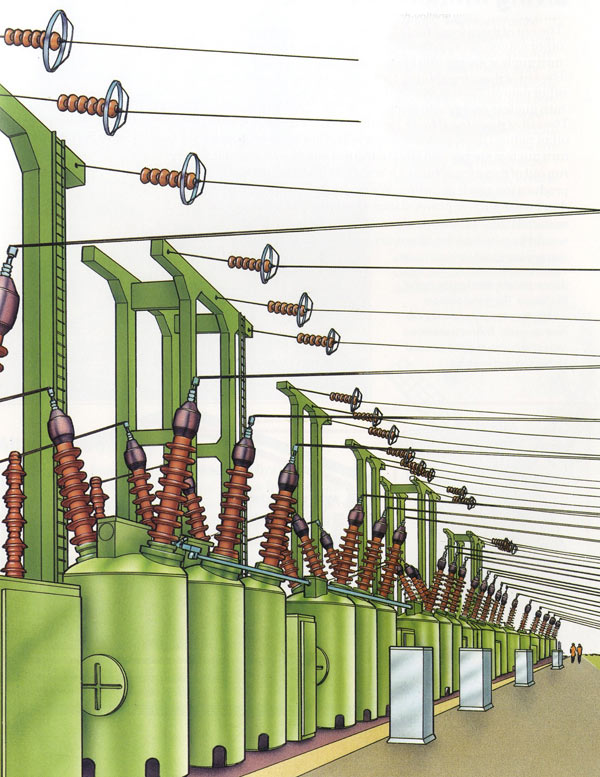
You can see a row of transformers at most power stations. At the top of each transformer there are round insulators. They prevent sparks of electricity from jumping between the high-voltage wires and causing a short circuit.

Electricity for Kids - What Does Voltage Mean?


You can make a bulb light up by using two wires to join it to a battery. 
The bulb lights up because an electric current is flowing through it. 
The battery produces the current by pushing electrons along the wires. 
The stronger the push, the more electrons flow along the wire each second. 
The current heats the thin wire inside the bulb and makes it glow brightly.

The force of this push is measured in volts. 

The word volts comes from the name of the Italian who invented the first battery—Alessandro Volta. 
The more volts a battery has, the stronger its push.
In a copper wire (A), some electrons move freely in all directions.
When a battery is connected to the wire (B), the battery pushes the electrons in the same direction.
An electric current can now flow along the wire.
When we do experiments with electricity, we use small batteries.
These batteries give a push of 1.5, 6.0, or 9.0 volts.
We describe this as the voltage of the battery.
This voltage is printed on the side of the battery.
The voltage of the power line to your home is much higher.
The voltage of the electricity flowing through the wires in most homes is at least 110 volts and may be as high as 220 or 240 volts.
A voltage of more than 100 volts is enough to push electrons through your body.
If a strong electric current passes through your body, the shock will hurt you badly and could easily kill you. So you must always use low-voltage batteries for your electrical experiments.

Electricity for Kids - What is Electric Wire?

Do you know how water gets to the faucets on your kitchen sink?
It comes through pipes.
Pipes let water flow in the direction we want it to go.
How do we make electricity flow in the direction we want it to go? 
The electrical energy we call "electricity" is made in huge power stations.
What connects the electric sockets in your home with the power station?
The answer is wires. 
Wires are the "pipes" of the electricity system.
A wire is a long, thin piece of metal. It may be a single strand of metal, or it may be two or more strands twisted together. Some wires are thick and stiff, and others are thin and bend easily.
Why are electric wires covered?
A material that allows electricity to flow through it is called a conductor. Metals are good conductors. Some metals are better conductors than others. Silver is the best conductor of all, but it is too expensive to use to make wires. Copper is also a very good conductor and much cheaper to use than silver. So most of the wires that we use to conduct electricity are copper wires.
But it's best not to try to conduct electricity along a bare wire. When a current is flowing through a bare wire, it will also flow through any metal object or other conductor that touches the wire. Even the human body can conduct electricity. If a person standing on the ground touches a bare wire which is connected to a power line, an electric current will flow through the person and into the ground. The person may receive a dangerous electric shock and might even be killed.
We need to make sure that electric current goes just where we want it and nowhere else. So the wires used to carry electricity are covered with materials that are poor conductors of electricity. Rubber and plastic conduct electricity poorly. They are both good insulators. A bare wire that is covered with rubber or plastic is called an insulated wire, or cable.

If cable is used for the circuit wires, there are three wires inside the cable. Two of these wires carry the electric current to and from the fuse box. One is a black, red, or blue wire and the other a white wire. The third wire, which can be bare or green, is called the ground wire. It may be connected to the main water pipe. If there is a fault in the wiring, the ground wire takes the current safely away into the ground.

Interesting Facts About the Sun

Interesting Facts About the Sun

Every morning the sun rises, bringing light and warmth to our world.
It is daytime.
The sun rises in the east, and during the day it appears to travel in an arc across the sky.
In the evening, it sets in the west.
As it disappears below the horizon, the earth becomes dark.
It is night.
However, this is not really what happens.
The sun only seems to move across the sky. It is the earth, not the sun,  that is moving.
The earth is spinning in space.
The sun moves into our view and out of sight again as the earth whirls around.

It takes the earth 24 hours to turn around an imaginary line that runs from the North Pole to the South Pole. We call this line the earth's axis.

Without the sun's light and heat, the earth would be a dark, cold world. 
Plants need sunlight to make their food.
Animals cannot make their own food. They must eat plants or other animals in order to live.

So without sunlight, there would be no living things.

What is the sun?

The sun is a star and is similar to the other stars in the sky. It appears bigger and brighter because it is much nearer than other stars.

The sun lies about 93 million miles (150 million kilometers) away.
The star nearest to us after the sun is over 25 million million miles (40 million million kilometers) away!

Heat from the sun warms the earth. The highest temperature recorded on earth was 136 °F (58 °C).

The temperature near the surface of the sun is 10,000 °F (5500 °C)!
At the sun's center, the temperature rises to about 27,000,000 °F (15,000,000 °C).

Sometimes we can see dark patches on the surface of the sun.
These are called sunspots.
We may also see arcs of gas called prominences or bursts of light called flares.
Prominences and flares are types of solar storms.
They usually happen above sunspots.

Scaling the sun

How does a light bulb work - for kids?

How does a light bulb work - for kids?

Have you ever looked closely at an ordinary electric light bulb?

Hold it carefully while you do so.

How does a light bulb work - for kids?

Inside, you may see wire "legs" holding up a thinner wire arranged in a coil.
When a light bulb is switched on, electricity flows along the thin wire and makes it glow.
Why does it glow white, and not red like the wire in an electric heater?
Why doesn't the thin wire quickly burn out?
Many bulbs are filled mostly with argon gas. Because argon is inert, or chemically inactive, it allows the wire to glow brightly without burning.
If the bulbs were filled with air or oxygen, the wire would be destroyed by burning.

The wire glows white because it is so hot—over 4500°F (2482°C). And it doesn't melt because it's made of a metal called tungsten, which melts only at extremely high temperatures.

Gases in bulbs

Sometimes the gas inside a lamp produces a colored light.
Different gases glow in different colors. Street lights that shine yellow contain sodium as a gas. Neon gas glows orange-red, and krypton makes a greenish-yellow light. In fact, different mixtures of gases in special lamps can produce many different colors.

In these lights, the electricity doesn't flow along a wire. It flows through the gas inside a thin, glass tube, making the gas glow. In a city at night, you can see lamps lighting up advertisements. These often flash on and off. Neon mixed with other gases gives them their different colors.
Halogen light is especially useful because it can be seen through thick fog. So it is often used in the warning lights at airports.

Xenon can be seen from long distances. That's why the high-powered electric lamps used in some lighthouses may contain xenon. Xenon is helpful to photographers, too. It is the gas used in the tubes of electronic flash units.

CHERNOBYL ACCIDENT - WHAT HAPPENED IN CHERNOBYL?

Nuclear power stations use a radioactive material called uranium as an energy source to make electricity.
Radioactive materials give out energy called radiation. It is a very powerful form of energy that is absorbed by everything around it.
Plants, animals, and people are affected by radiation. It attacks the cells which make up our bodies. Radiation energy remains active for a long time.

WHEN WAS THE CHERNOBYL ACCIDENT?

Early in the morning of April 26,1986, alarm bells began to ring at a poorly constructed power station at Chernobyl in the Soviet Union. Soon after, there was an explosion at the power station, which sent a dangerous cloud of radioactive material into the air. The cloud contained radiation that is harmful to all living things.
Radioactive clouds swept across many parts of Europe during the days following the explosion at Chernobyl.

Chernobyl nuclear power plant

For a few days after the explosion, wind spread the radioactive cloud over central and northwestern Europe. Some people died as a result of the accident, and many people were seriously injured. Others are still suffering from the effects of radiation sickness. Radioactive rain fell on land on which animals were grazing.
 Chernobyl radiation map

 After the accident, animals that had eaten radioactive grass could not be used for milk or meat. Many more people will probably die or become ill from the radioactivity, which will remain active for many years.
 Chernobyl effects on people

The world needs electricity.
Nuclear power is one way of producing it.
But what if there is another, even more serious accident?
Such accidents are possible, even at power plants better constructed than the one at Chernobyl.

HOW IS BIOGAS MADE?

Dead animals and plants rot and decay. In swampy areas, for example, dead plants fall into the water. As they decay, they give off - gas. 

Scientists call this biogas.

Biogas comes from garbage, sewage, and manure, too.

Biogas is a source of cheap energy for many villages in China. Many vehicles are fueled by methane, a mixture of biogas and carbon dioxide.

Biogas is a valuable source of energy that is often wasted. When materials decay, the biogas mixes with carbon dioxide, forming a gas called methane. Large amounts of methane can be dangerous—a tiny spark near the gas can cause an explosion. But if methane is collected safely and stored correctly, it can provide an important source of energy.

Drawing of biogas production facility at a farm

Biogas could be important in countries where other fuels are scarce or too expensive. A small village can use its own garbage and sewage to produce biogas. People collect the droppings of farm animals and put them in a tank. Some of the waste turns into liquid. 

The liquid soon starts to give off methane, which is kept in a storage tank that has an expandable lid. The gas can be used in homes for cooking and heating, or as fuel to power an engine or an electric generator.


Is biogas eco-friendly fuel?

Compared to natural gas, which is extracted by drilling in the ground, biogas is obviously a more sustainable option. Natural gas is obtained through fracking, a process in which water, chemicals, and sand are forced deep into the ground to break up rock formations. The fracking process can seriously damage ecosystems and landscapes. 

Another benefit of biogas is that it eliminates the large amounts of animal manure and food waste from the environment, and thus prevents nitrogen pollution and leakage into water resources. 

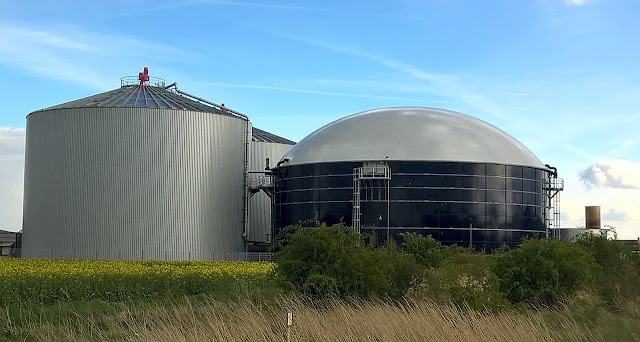
Biogas production facility


Biogas also helps reduce methane emissions that would otherwise escape from manure dumps or lagoons. Using this methane as a fuel drastically reduces its impact on the climate by converting it to CO2, which is up to 34 times less efficient than a greenhouse gas.

But in contrast to energy generation using wind power or solar energy, during biogas production, greenhouse gases are released into the atmosphere through the systems. Methane in particular can escape at various points in production. 

In addition, biogas also contains nitrogen, carbon dioxide, and nitrous oxide, among other things. The latter is only represented in small proportions but is even around 300 times as harmful as CO2. In addition, if the biogas from the plants is burned to generate energy, CO2 is produced in turn.

In addition, the transport of energy crops to the plants contributes to the negative balance of biogas.

What are the advantages of biogas?

The production of biogas brings important benefits for the environment and society :
1. Biogas is a green energy source, from which electricity and heat can be obtained.
2. Biogas is created through the fermentation of renewable raw materials, replaces fossil fuels and thus reduces greenhouse gas emissions.
3. The combustion of biogas only releases as much CO2 as the plants previously absorbed during growth. This means that biogas is one of the CO2-neutral fuels.
4. Unlike wind, water or solar energy, biogas is available without fluctuations and can be stored without any problems.
5. With biogas, organic waste from industry and households is recycled in an environmentally friendly manner.
6. Less odor nuisance when spreading liquid manure in the fields: fermented liquid manure smells considerably less than normal liquid manure and the smell wears off faster.
7. Plants absorb the fermentation substrate better than normal manure, which can increase the yield in the fields.
8. The cost of artificial fertilizers can be reduced and environmental pollution avoided.

IS GEOTHERMAL ENERGY RENEWABLE? – YES, FIND OUT WHY

The Geothermal energy is renewable, clean and sustainable energy generated from the Earth’s heat, which is constantly replenished.
At the center of the earth, it is very, very hot.
The temperature is thought to be about 13,000 °F (7000 °C), which is hot enough to melt rock.
The heat spreads to the rock around the center of the earth and to water trapped between the layers of rock. In some parts of the world, this hot water is close to the earth’s surface. By pumping it out of the ground as hot water or steam, engineers have tapped a new source of energy.
This energy is called geothermal energy, which means it is heat energy from under the ground.


HOW IS GEOTHERMAL ENERGY PRODUCED?

Do you know what it is like at the center of the earth?

It is very, very hot.
The temperature is thought to be about 13,000 °F (7000 °C), which is hot enough to melt rock.

The heat spreads to the rock around the center of the earth and to water trapped between the layers of rock. In some parts of the world, this hot water is close to the earth’s surface. By pumping it out of the ground as hot water or steam, engineers have tapped a new source of energy. This energy is called geothermal energy, which means it is heat energy from under the ground.

Tropical fruit grows in Iceland!


Hot water from inside the earth may be used directly to heat buildings. In Iceland, where there are many hot springs, hot water heats greenhouses and swimming pools as well as homes. And although Iceland is close to the Arctic Ocean, people living there can grow bananas and other tropical fruit in their greenhouses!

Steam condenses into white clouds of water vapor rising from these hot springs in Iceland. Several countries have developed geothermal power plants to heat homes and generate electricity.

In one kind of geothermal power station, cold water is pumped down a pipe into the earth and is heated     by hot rock. Another pipe brings the hot water to the surface.

Several countries in the world, including the United States, Italy, and New Zealand, have built geothermal power stations. Steam, coming out of the ground at high pressure, is used to run steam turbines that generate electricity.
Engineers are trying to find out how more countries might use geothermal energy.
They started with a question. If the rock below the surface is hot but there is no water down there, why not drill a hole through the rock, pump cold water down and let the rock heat it up? Then the water could be pumped up again through a second hole.
Some engineers are working on an even better idea. They want to build a geothermal power station underground, which would generate electricity. Then only an electric cable would be needed to bring the electrical energy to the surface of the earth.

HOW DOES TIDAL POWER WORK?

Have you ever watched the sea during a storm?
The waves crash down with enormous energy. Sometimes they are strong enough to damage seaside walls and buildings, or even make cliffs crumble.
Do you know how we can make use of energy from the waves?
One idea is to place a line of rafts floating on the sea. These rafts move up and down with the waves, and their kinetic energy can be converted to electricity. One type of raft is the Salter duck, named after its British inventor, Stephen Salter. Salter ducks bob up and down as the waves pass by. Their movement produces energy that pumps water through a turbine, which then turns a generator.

As the tide water flows out, it passes through turbines to generate electricity. There are few large tidal power stations because they are expensive to build.

The energy in the sea’s tides, which rise and fall every day, can be converted to hydroelectric power. When the tide comes in, the water is stored behind a dam. When the tide goes out, the water flows from the dam through a turbine and produces electricity. There are tidal power stations in northern France, on the Annapolis River in the Canadian province of Nova Scotia, and at Murmansk in Russia.

HOW DOES WIND POWER WORK?

The wind has been a source of energy for thousands of years.
Before the development of the steam engine, most ships relied on wind power to fill their sails and push them along. Windmills were used to turn grindstones and pump water.
Now scientists are turning to wind power again. This time they are using it to generate electricity.
Windmills have been used to produce electricity since the early 1900’s. It is easy to produce electricity from a wind turbine. This is simply a windmill that converts the kinetic energy of the wind into electricity.
Small wind turbines are used by farmers in remote parts of Australia and North America. In wide, open spaces, these turbines can make some of the electricity that farmhouses need. However, the winds are sometimes so strong that they damage the turbines and put them out of action.
Engineers have designed many different kinds of wind turbines to try to solve this problem. Some turbines look like old-fashioned windmills, with four blades, or sails. Other, more modern ones have two blades like those of an aircraft propeller.

In North America, this type of traditional windmill is used to pump water.

One of the largest wind turbines in the world stands in Hawaii, in the Pacific Ocean. It has two blades 165 feet (50 meters) long on top of a high tower. There is a smaller turbine on Orkney, off the coast of Scotland. It can generate enough electricity for about 1,000 homes. Most wind turbines are mounted on a cap, or swivel, on top of a tower. This means that they can be turned to face the wind when its direction changes.
A huge power station driven by wind has been built in the Mojave Desert in California. Its owners call it a “wind farm.”  Hundreds of wind turbines are arranged in rows and all are linked together by wires. The electricity they produce is supplied to the California power pool.
These wind turbines supply electricity to homes and factories.

HOW SOLAR POWER WORKS?

More energy reaches earth from the sun than could be converted by millions of power stations.
The sun’s energy costs nothing, but how can we use it?
We can use the sun’s energy to heat the water in our homes. One way this can be done is with a solar panel. This is a glass-topped box fixed to the roof of a building, facing the sun.

The inside of the box is painted black. Black is best at taking in, or absorbing, heat. Water flows through pipes inside the box. During daylight, this water is heated by the sun’s energy.

Heat can be produced by using mirrors to direct and concentrate the sun’s rays. One solar furnace in southern France uses a giant, curved mirror to collect sunlight from a series of smaller mirrors.
The mirror then directs the sun’s energy onto a huge furnace. A solar power station in the Mojave Desert, in the United States, uses 1,800 mirrors.
Solar cells, also known as photovoltaic cells, are made of layers of a material that produces electrical energy when light shines on it. The solar cell converts the sun’s energy into electrical energy.
Watches and calculators can be fitted with solar cells. We say that they are solar powered, although they use indoor lighting, too. Larger solar cells provide electrical energy in places that are far from normal electricity supplies.
Most artificial satellites are also powered by solar cells.

HOW DOES HYDROELECTRIC POWER WORK?

Did you know that a power station can produce electricity without burning coal or oil, and without using nuclear fuel?
How?
A power station can turn the potential energy of water into kinetic energy and then convert this energy into electrical energy by using a generator. This kind of power station is called a hydroelectric power station.

Hydroelectric power stations are usually found in mountainous areas where there is plenty of rainfall. A large dam built across a river holds back a huge lake of water. Pipes carry the water downhill to a kind of waterwheel, called a water turbine, which is connected to a generator.

There are two kinds of water turbines. Inside an impulse turbine, water flows onto the blades or paddles of a paddle-wheel and forces it to turn. In a reaction turbine, water flows out of tiny jets fixed to a wheel. As the water squirts out, the wheel turns. Water turbines thus convert the energy of moving water into electrical energy.

The water held by this dam has high potential energy. When the water rushes down to drive the turbines, the potential energy becomes kinetic energy.