Making Flies for Fly Fishing - Fly Fishing Basics

NATURAL FLY-FISHING, OR DIPPING.

Fishing with a fly may be practised either with the natural fly, usually called “dipping,” or with the artificial fly; in which latter case the sport is called “fly-fishing,” or sometimes “whipping.”
Dipping requires a moderately long and stiff rod, of about twelve or thirteen feet. The line should not be above a yard in length from the end of the rod, but the reel should contain sufficient to play the fish if necessary. When the river is much overhung with bushes, it is a good plan to wind the line round the end of the top joint, leaving only a few inches dependent; and then, having thrust the rod through some small opening in the bushes, gradually to unwind the line by turning the rod in the hand, so as to drop the fly on the water in the most gentle manner.
In this insidious way large fish are often taken with any of the flies which are in season and found at the time on the banks of the river which is fished, especially if they are only just coming out, and the fish are not yet satiated with them. It is quite needless to give a list of the natural flies which are likely to prove serviceable to the fisherman, because he has only to look for those which at the time are tempting the fish, and then to endeavour to find them on the banks, and at once to try their powers.
In the case of chub, however, he will find grasshoppers and humble-bees more useful than any of the flies, and yet they are neither of them often seen upon the waters, and may be considered exceptional cases. The fish which will generally take the natural fly are grayling, trout, chub, and dace.

FLY-FISHING AND ARTIFICIAL FLIES.

For this delightful sport, which captivates alike the sexagenarian and the schoolboy, rods and tackle of the finest quality are required. It is true, that a good workman will take fish even with a willow wand, but still he would do far better with a rod turned out by a good maker; and few young hands will be able to do much without a well-finished specimen of the art of rod-making.
The rod should be strong, yet fine, and either of dressed silk, or silk and hair mixed. The lower portion, called the foot-length, is of gut, generally occupying about five or six feet of it, to which one, two, or three flies are attached, the one at the end being called a stretcher, and the others droppers.

The fly-fisher should be able to make his own flies, as there is a great advantage in being able to “do for oneself;” and it may sometimes happen that he may be out of a particular fly when far away from “fly shops.”

MATERIALS FOR MAKING FLIES.

Feathers of various kinds; hairs of various kinds; very fine sewing silk; gold and silver twist. Of the first, the young fly-fisher must provide himself with the feathers of the duck, cock, grouse, snipe, bittern, woodcock, partridge, landrail, starling, jay, golden plover, and peacock. Of the second, the fur from Tommy’s tail, from the skins of squirrels, moles, and water rats, camel’s hair, hare’s ear, fur from its neck, the yellow fur from the neck of the martin, mohairs of different shades, camlets, black horsehair, hog’s down dyed various colours. And with these, gimps, silks, and tinsel, a good pair of pliers, and a pair of fine-pointed scissors.

In making your fly, imitate as nearly as possible the natural fly you wish to represent; to do this properly, it will be well to dissect a natural fly, and to imitate its several parts, and then to reconstruct it with a reference to the whole. With a hook of the proper size, and a feather of the right colour, the fly-maker may now commence. His feather must be stripped down on each side, leaving just so much as will do for the wings at the fine end; a piece of fine gut, free from imperfection, and properly tested as to its strength; dubbing or hackle; and a piece of fine silk well waxed with shoemaker’s wax.

Let the essay be now made. Hold your hook in the left hand, wrap the silk round the bare hook two or three times, and put the finest end of the gut on the under side of the hook. If you are working for a tackle fly, begin at the band and work up to the head, after turning three or four times round the hook and gut; fasten on the tackle, and continue the winding of the silk until it reaches the end of the hook, then turn it back two or three times, to form the head. The dubbing must now be twisted round the silk, and wrapped upon the hook for nearly half the proposed length of the body; fasten it there by a single loop, that both hands may be at liberty to manage the tackle.

When sufficient of the feather is wound upon the hook, the remainder should be held under the thumb of the left hand, and the entangled fibres picked out with a needle. The silk and dubbing must now be twisted over the end of the tackle, until the body of the fly is of the length required, and then fastened. If gold or silver twist is used, the twist should be fastened to the lower end of the body before the dubbing is applied to the silk.

To make a winged fly, the same method must be observed in tying on the hook; then take the feather which is to form the wings, and place it even on the upper side of the shank, with the roots pointing towards the bend of the hook; fasten the feathers, by winding the silk over it, and cut the root end close with a pair of scissors, and divide the wings as equally as possible with a needle, passing the silk two or three times between them, to make them stand in a proper position; bring the silk down the shank of the hook the proposed length of the body, and fasten it, then apply the dubbing to the silk, and twist it towards the wings; fasten in the hackle for legs, and wind it neatly under the wings, so as to hide the ends of the cut fibres: the silk must be fastened above the wings—be careful of this.

It would be impossible for us, nor would it be very useful to the young fly-fisher, to give him directions for making every kind of fly. We may, however, throw out a few hints concerning the making of most of the flies in common use, and of the materials employed.
Green drake

1. The green drake or May fly.

This is one of the most killing trout flies, but it is seldom in the water for a longer period than three weeks. The time of its appearance varies in different rivers, but it generally rises about the last week in May, and continues for about three weeks. The wings are made of the light feathers of a grey drake, dyed a pale yellow-green colour, by being boiled for a minute or two in a decoction of green vitriol. The body is formed of amber-coloured mohair or silk ribbon, with dark green silk; the head of peacock’s harl, and the tail of three long hairs taken from a sable muff.

2. The black gnat.

The body of this fly is made of black ostrich harl, and the wings of a pale starling’s feather; it must be dressed short and thick. It is in use from the end of April till the end of May, and is a good killer when the water is low.

3. Hare’s ear.

The wings are made from the feather of a starling’s wing, the body from the fur of the hare’s ear, the legs of a ginger cock’s hackle.

4. Cock tail.

Wings of the light feather from a snipe’s wing, the body of yellow mohair.

5. Whirling dun.

Wings of a snipe’s feather, body of blue fur wrapped with yellow silk, and a blue cock’s hackle for legs; the tail of two hairs from a coloured muff.

6. Grey drake.

Wings of a dark grey feather of the mallard, the body of white silk, striped with dark silk, the head of a peacock’s harl, and the tail of three hairs from a sable muff.

7. Cowdung fly.

The wings of the feather of a landrail, the body of yellow camlet, mixed with a little brown bear-fur, and a ginger hackle for legs; the wings should be dressed flat.

8. Bee fly.

The body of thread of various colours, arranged in stripes of the following order:—black, white, light yellow, white, black, white; the legs of a black hackle; the wings from the feathers of a blue pigeon’s wing: the body must be dressed thick.

9. Red palmer.

The body of dark-red mohair, ribbed with gold twist, and wrapped with a red cock’s hackle.

10. Peacock palmer.

The body of a peacock’s harl, wrapped with a dusky-red cock’s hackle.

11. Kingdom fly.

Wings of a woodcock’s feather, the body of white silk, striped with green, and the legs of a red cock’s hackle.

12. White gnat.

The wings of a small white feather, the body of white silk, and the legs of a red cock’s hackle.

13. Blue dun.

The wings of a starling’s feather, the body of blue fur from a water rat, mixed with a little lemon-colour mohair; the tail is forked, and should be made of two fibres from the feather used for the wing.

14. Red ant.

The wings of a light starling’s feather, the body of peacock’s harl made thick at the tail, and a ginger hackle for legs.

15. Gold spinner.

Wings of a starling’s feather, body of orange silk, ribbed with gold twist, and the legs of a red hackle.

16. Great white moth.

Wings of a feather from the wing of a white owl, the body of white cotton, and a white cock’s hackle wrapped round the body.

17. Governor.

Wings of a woodcock’s feather, the body of a peacock’s harl, tied with orange silk.

18. March brown.

Wings of the dark mottled feather from the tail of a partridge, the body of fur from a hare’s ear, well mixed with a little yellow worsted, and a grizzled cock’s hackle for legs.

19. Stone fly.

Wings of a dusky-blue cock’s hackle, or a mottled feather from a hen pheasant, the body of dark-brown and yellow camlet mixed, and a grizzled hackle for legs; the wings should be flat.

20. Black silver palmer.

The body of black ostrich harl, ribbed with silver twist, and wrapped with black cock’s hackle.

21. Willow fly.

The wings of dark grizzled cock’s hackle, the body of blue squirrel’s fur, mixed with yellow mohair.

22. Yellow palmer.

The wings of white hackle, dyed yellow, the body of yellow silk.

23. Black palmer.

The body of black ostrich’s harl, wrapped with a black cock’s hackle.

24. Black palmer ribbed with gold.

The body of peacock’s harl, wrapped with a black cock’s hackle, and ribbed with gold twist.

25. Marlow Buzz or Cock-a-Boundhu.

This is one of the most killing flies known, and should never be off the line during the trout[119] season. The body of peacock’s harl, ribbed with gold twist, and a dark-red cock’s hackle over all.

26. The Grouse Hackle.

This is also a very killing fly, especially late in the evening, during June, July, and August. Body of brown fur, ribbed with gold twist, and a grouse hackle over all; hook No. 10.

The foregoing list comprises twenty-six of the most killing flies; and the following are the months in which they will be found to kill best.

February, red cowdung fly, blue dun; March, brown; April, black gnat, stone fly, gravel or spider fly, the green tail, brown, blue dun; May, green drake, grey drake, oak fly, hazel fly, little iron blue and yellow sally; June, hare’s ear, cock tail, whirling dun, marlow buzz, bee fly, kingdom fly, white gnat, blue gnat, blue dun, governor, fern fly; gold spinner; July, red ant, red spinner, yellow dun, coachman, fern fly; August, whirling blue, red spinner, pale yellow dun; September, willow fly, silver twisted blue, whirling blue.

It would of course be impossible, in a work of this description, to give a list of all the artificial flies used by experienced fishermen, but the above are a few of the most killing. For bleak, dace, roach, chub, &c. a piece of a maggot, or a small piece of white leather, should be placed at the end of the hook.

Having thus given the “order of flies,” natural and artificial, we may imagine the young fly-fisher, with rod in hand, proportionate to his strength and the breadth of the stream, ready to throw his fly; but let his rod and running tackle be in good order, and the idea of the coachman’s whip out of his mind. He is not to flog the water, but to tickle it. The novice should teach himself to handle the line, by beginning with it alone, (i. e. without flies or hook,) trying a short length first, and lengthening it gradually. In using the rod, it should be drawn vigorously back, though without a jerk, and thrown forward again when the line has reached its full extent behind. Take care in doing this, that the fly be not whipped off. When tolerably expert, put on one fly, and try awhile with that, adopting two or three when able to use them properly.

In fly-fishing keep as far from the water as possible, especially if fishing for trout. Let only the flies touch the water, and keep moving them gently and slowly on the surface. When a fish rises, let not a moment elapse before you strike, and do it sharply.

When you have two flies on your line, you must try to throw your line so that the bottom fly shall reach the water first; it must be done always as lightly as possible, so that it may resemble a natural fly settling upon the water. You must suffer the line to float gently down the stream, at the same time working it towards you.

The best time for angling with the fly is when there is a gentle breeze upon the water; south and west winds are to be preferred, when the water has been disturbed by heavy rains and is just resuming its natural colour, or when the day is dull and cloudy. The best[120] time, morning and evening. In cold weather the fish bite deeper, and you should then let the fly sink a little. Take care to have the wind in your back, and the sun in your face, if possible.

When you see a rise, throw your fly about half a yard above the fish’s nose, and let it fall down with the stream; watch it narrowly, and strike as the fish rises, giving him an “infinite little moment” to taste. When you have hooked, play your fish carefully, keeping up his head and running him down the stream, at the same time steering him towards you. If you see a fish rise at a natural fly, throw your bait a little before him, so that he may take it as “one of the number.”

To know what flies the fish are most likely to take, observe what natural flies are about the water, or on the grass, trees, or bushes in the vicinity of the river; and take that fly which is the most in abundance, either natural or artificial at your discretion.

Such are a few practical particulars concerning angling and fly-fishing, sufficient to enable any young angler to begin. For more abundant information we refer him to Mr. Stoddart and Mr. Stewart, for fly-fishing, Mr. Cholmondeley Pennell for pike-fishing, “Hewitt Wheatley” for grayling fishing, and Mr. Francis Francis for the various modes of bottom fishing.

Excerpt from the book:
EVERY BOY’S BOOK: A COMPLETE ENCYCLOPÆDIA OF SPORTS AND AMUSEMENTS.
EDITED BY EDMUND ROUTLEDGE.
With more than Six Hundred Illustrations
FROM ORIGINAL DESIGNS.
LONDON: GEORGE ROUTLEDGE AND SONS,
THE BROADWAY, LUDGATE.
NEW YORK: 416, BROOME STREET.
1869.
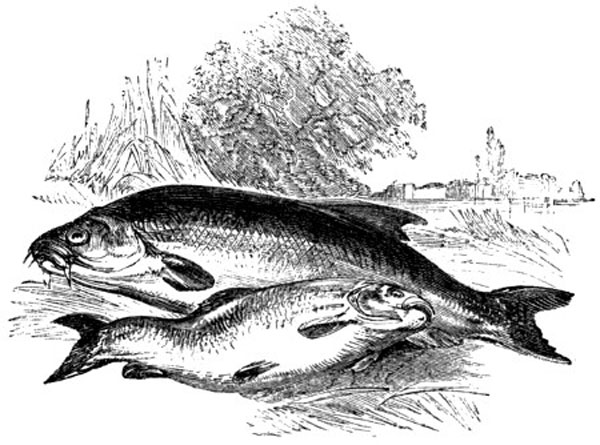
Barbel Fishing Tips - How to Fish for Barbel

The barbel is a bold, sturdy, handsome-looking fish, although its flesh is coarse to the eater; but he is a rare fellow for sport, and often affords great amusement as well as chagrin to the angler by his bolting off with the line by a “coup de barbel,” and breaking it with his tail.
Izaak Walton says, that barbel “flock together like sheep.”

Barbel are to be found in the strongest runs of water. In summer, they love the shallowest and sharpest streams, and will lurk under weeds, and will root and dig in the sand like pigs.
Sometimes he retires to deep and swift bridges, or to flood-gates or weirs, and will rest himself against piles or hollow places.
In winter he gets into deep water.
BARBEL WITH GOLD CARP.
In fishing for barbel in large streams, you should go out in a boat provided with greaves, gentles, and red-worms; and, before you begin fishing, you should throw in plenty of groundbait—such as soaked greaves, bran and clay made into small balls, maggots, or lob-worms.
They may be angled for with a stout rod, strong running line, cork float, and No. 7 or 8 hook, baited with marshworms or greaves.
The barbel being a sharp biter, strike the moment you feel a nibble. He may be caught from May to October all day, but best in the morning and evening.
After he is struck he will frequently make a run, but you must play him gently; keep him clear of weeds, and try to get him into deep water; and when you have him, mind he does not bounce out of your hand and drop down the stream again.

Excerpt from the book:
EVERY BOY’S BOOK: A COMPLETE ENCYCLOPÆDIA OF SPORTS AND AMUSEMENTS.
EDITED BY EDMUND ROUTLEDGE.
With more than Six Hundred Illustrations
FROM ORIGINAL DESIGNS.
LONDON: GEORGE ROUTLEDGE AND SONS,
THE BROADWAY, LUDGATE.
NEW YORK: 416, BROOME STREET.
1869.

Eel Fishing Tips - How to Fish for Eels

Eels are denizens of the mud; but they are fond of clean not foul mud, and ought never to be sought after in filthy places. There are many modes of taking them: by rod and line, by dead line, by sniggling, by bobbing, and by spearing.
When a rod is used, you should put a brandling or red-worm on a No. 8 hook; the bait should touch the bottom; and, when you have a “bite,” the float should be drawn quite under water before you strike.
Eel
The dead line is a line of whipcord, with hooks about two feet asunder, baited with lob-worms or small fish, and having a weight at the end.
You should also have a bank-runner—a reel on a pin or stake stuck into the ground on the edge of the bank; the line and baits should be thrown in, and left for the eels to amuse themselves with,—looked to, and drawn up at your leisure.
In sniggling, a lob-worm is put upon a stout worsted needle; the line is on a winder; and the fish will be found near flood-gates, wharfings, bridges, piles, holes in the banks of rivers, ponds, and canals.
The bait should be put into the lurking-places of the eel, by means of a stick with a forked head; and when the bait is taken, which will easily be known by the pull of the string, strike.

Bobbing for eels.

In this process long red-worms are strung on threads of worsted, until a bunch as large as the two fists is formed around a piece of lead. The whole is sunk to the bottom, or nearly so, then raised a little, then depressed, so as to induce the eels to bite.
When this occurs, heave up without hurry.
The number of eels taken in this way is often prodigious.

In spearing eels, the spearer usually goes into the mud in a pair of pants or mud pattens, pieces of square board fastened into the heel to prevent sinking.
He takes an eel-spear in his hand, something like Neptune’s trident, and progs the mud all over, and the eels are caught between the forked blades of the spear.
Great numbers of eels are taken in this way on the muddy ooze of salt or fresh-water rivers.

Excerpt from the book:
EVERY BOY’S BOOK: A COMPLETE ENCYCLOPÆDIA OF SPORTS AND AMUSEMENTS.
EDITED BY EDMUND ROUTLEDGE.
With more than Six Hundred Illustrations
FROM ORIGINAL DESIGNS.
LONDON: GEORGE ROUTLEDGE AND SONS,
THE BROADWAY, LUDGATE.
NEW YORK: 416, BROOME STREET.
1869.

Flounder Fishing Tips - How to Fish for Flounder

The flounder is a well-known flat-fish very common about our own coasts; and should any of our young friends be at the seaside, it is well that they should know how to take flounder.
They are also found in rivers, at some distance from the sea.
They may be taken in May, July, and August,—not in June, as that is their spawning time.
The best baits are red-worms and marsh-worms, on a No. 6 hook; and you should fish at the bottom.
THE FLOUNDER.

Excerpt from the book:
EVERY BOY’S BOOK: A COMPLETE ENCYCLOPÆDIA OF SPORTS AND AMUSEMENTS.
EDITED BY EDMUND ROUTLEDGE.
With more than Six Hundred Illustrations
FROM ORIGINAL DESIGNS.
LONDON: GEORGE ROUTLEDGE AND SONS,
THE BROADWAY, LUDGATE.
NEW YORK: 416, BROOME STREET.
1869.

Tench Fishing Tips - How to Fish for Tench

The tench is one of our most useful fresh-water fishes, for the ease with which it may be preserved, and the goodness of its flesh.
It is very usual to breed it in ponds, but naturally, like many others of the carp tribe, it is generally found in lakes and still waters; its favourite haunts are in places well shaded with bushes or rushes.
In standing waters, it lies under weeds, near sluices, and at pond-heads.
Tench
The best baits for tench are bread paste and red worms, but he usually prefers the latter.
He feeds best in the three hot months. The worm should be put on the hook in the method directed for perch, but the hook itself should be of a somewhat smaller size.
Use a light float and strong gut line, and let the bait swim within an inch or two of the bottom.


Excerpt from the book:
EVERY BOY’S BOOK: A COMPLETE ENCYCLOPÆDIA OF SPORTS AND AMUSEMENTS.
EDITED BY EDMUND ROUTLEDGE.
With more than Six Hundred Illustrations
FROM ORIGINAL DESIGNS.
LONDON: GEORGE ROUTLEDGE AND SONS,
THE BROADWAY, LUDGATE.
NEW YORK: 416, BROOME STREET.
1869.

Carp Fishing Tips - How to Fish for Carp

Carp are esteemed among the richest fresh-water fish we have in the kingdom, and are as cunning as foxes.
The angler, therefore, must be “wide awake” to catch him, and also as patient as a saint.
He may, however, fish for him at any time in the day during warm weather.
The bait may be either worms or paste. Of worms, the bluish marsh or meadow is the best; but a red-worm, not too big, will do: of paste, the best is made of bread and honey; and the spot intended should be well baited beforehand.
In a large pond, to draw them together, throw in either grains, or soaked bread worked up with meal or bran; follow this with a few of the small baits you intend to angle with.
Carp
Whilst you are fishing, chew a little bread, and throw it in about the place where your float swims.
In fishing for carp in ponds, the bait and about half a foot of the gut nearest the hook should lie on the bottom; otherwise the carp will continually suck the bait off. When the carp has fairly taken the bait, you will perceive the float move steadily away or under water, then strike, and not till then.
In this way, with due patience, you will prove a match for these crafty fish.

Excerpt from the book:
EVERY BOY’S BOOK: A COMPLETE ENCYCLOPÆDIA OF SPORTS AND AMUSEMENTS.
EDITED BY EDMUND ROUTLEDGE.
With more than Six Hundred Illustrations
FROM ORIGINAL DESIGNS.
LONDON: GEORGE ROUTLEDGE AND SONS,
THE BROADWAY, LUDGATE.
NEW YORK: 416, BROOME STREET.
1869.

Chub Fishing Tips - How to Fish for Chub

Chub Fishing Tips. This fish takes its name from the shape of the head, not only in our own, but in other languages. The head and back are of a deep dusky green, the sides silvery. The tail is forked, and very black at the end, and altogether the chub is rather a handsome fish, although its flesh is not much in esteem.

The haunts of the chub are in rivers whose bottoms are of sand or clay, or which flow over a gravelly bottom, in deep holes, under hollow banks; in summer, particularly where shaded by trees, &c. they frequently float on the surface, and are sometimes found in streams and deep waters, where the currents are strong. In ponds fed by a rivulet they grow to a large size.
Chub
To fish for chub at the bottom, you should have a stout long rod, a strong line (and if you use a reel, you will be the better able to fish under bushes), with two yards or more of the best silkworm gut at bottom; a hook proportionate to the bait used; a swan-quill float; and the line so shotted, eight or ten inches from the hook, as to sink the float to a quarter of an inch above the surface. The same groundbait is to be used as for carp. The best baits are greaves, cheese paste, or the tail end of a well-scoured lob-worm. The cockchafer is also a very tempting bait, especially towards dusk: no float or shot are required for this.

After baiting your hook with a cockchafer, move it two or three times near the surface, as in the act of flying; then drop it in the water, tapping the rod gently, which will cause the appearance of its struggling to escape. This attracts the chub, who are so fond of this bait, that they will rise two or three at a time to seize it. But mind and be ready with your landing-net.

The chub will take a grub, wasps, maggots, paste of fine new bread worked in the hand, and tinged with vermilion, to make it look like salmon-roe; but the best bait for bottom or float-fishing for the chub is new Cheshire cheese, worked with the crumb of a new roll, or the pith from the backbone of an ox. In baiting with the cheese, put a round lump the size of a cherry on a large hook, so as to cover the bend, and some way up the shank; fish six inches from the bottom, or in cold weather the bait may lie on the ground. When there is a bite, the float will be drawn under water: strike immediately, and give him play, holding a tolerably tight line, to keep the fish clear from weeds and stumps.

The best time for fishing for chub is chiefly before sunrise to nine in the morning, and from four till after sunset in the summer; but, in winter, the middle of the day is best. In hot weather, the chub is to be fished for at or near the top of the water, and not deeper than midwater; and in cold weather, close to or near the bottom; and the main point in taking the fish is for the angler to keep himself out of sight. A very deadly way of killing chub, and certainly the most artistic method, is with the artificial fly, used as in trout fishing. Flies are made expressly for this purpose, and of these the best are red and black palmers, and the Marlow buzz.

Excerpt from the book:
EVERY BOY’S BOOK: A COMPLETE ENCYCLOPÆDIA OF SPORTS AND AMUSEMENTS.
EDITED BY EDMUND ROUTLEDGE.
With more than Six Hundred Illustrations
FROM ORIGINAL DESIGNS.
LONDON: GEORGE ROUTLEDGE AND SONS,
THE BROADWAY, LUDGATE.
NEW YORK: 416, BROOME STREET.
1869.

Grayling Fishing Tips - How to Fish for Grayling

The grayling is a fish of elegant form; the back is of a dusky purple, the sides of a fine silvery grey, with the scales in long parallel rows or lines (from which the fish derives its name), marked with black spots, irregularly placed.
It is rather a hog-backed fish; and, from the nose and belly touching the ground together, is supposed to feed mostly at the bottom. In length it seldom exceeds sixteen inches, but some have been caught upwards of five pounds in weight.

Grayling

The haunts of the grayling are in rapid, clear streams, particularly such as flow through mountainous countries. They are usually taken in the same manner as the trout, and with similar baits.
They do not bite freely till late in August, or early in September, and may be found at the tails of sharp streams and in deep water. They rise more boldly than the trout, and if missed several times will still pursue the bait.
They will bite during the whole of the cold cloudy days; but the preferable time to look after them is between eight and twelve o’clock in the morning, and from four in the afternoon till after sunset.
Grasshoppers, wasp-grubs, maggots, and the artificial fly, are the most killing baits.


Excerpt from the book:
EVERY BOY’S BOOK: A COMPLETE ENCYCLOPÆDIA OF SPORTS AND AMUSEMENTS.
EDITED BY EDMUND ROUTLEDGE.
With more than Six Hundred Illustrations
FROM ORIGINAL DESIGNS.
LONDON: GEORGE ROUTLEDGE AND SONS,
THE BROADWAY, LUDGATE.
NEW YORK: 416, BROOME STREET.
1869.

How to fish for Perch - Perch Fishing Tips

“Perch feed on perch,” is an old maxim; the perch being the only one of all fresh-water fish that feeds on its own kind. His excuse is a prodigious appetite, like that of Saturn, who ate his own offspring.
Not withstanding this wicked propensity, the perch is a beautiful fish, the back and part of the sides being a deep green, marked with broad black bars, pointing downwards; the spaces between are golden, the belly white, and the fins tinged with scarlet.
They vary greatly in size. The largest perch we ever caught weighed three pounds twelve ounces, and was taken with a roach bait near Richmond.
Their general length is about ten or twelve inches.
Perch
Perch are found in ponds and in clear rivers with pebbly, clayey, or sandy bottoms. They are fond of water moderately deep, and frequent holes near to gentle streams where there is an eddy, the hollows under banks, among weeds and roots of trees, piles of bridges, or in ponds which are fed by a brook or rivulet.
The perch is a bold biter in the summer, but scarcely ever in the winter.
In the middle of a warm sunshiny day, you are sure to have him with a proper bait. In the winter he bites best in large quiet eddies, to which he retreats after the first heavy flood.

The baits for perch are various, as well as the manner of using them. Of worms, the best are brandlings, and red dunghill-worms, well scoured.
The hook may be varied from No. 2 to 6, being well whipped to a strong silkworm gut, with a shot or two a foot from it. Put the point of the hook in at the head of the worm, out again a little lower than the middle, pushing it above the shank of the hook upon the gut; then put the point of the hook into the worm again the reverse way, and draw the head part down so as to cover the hook entirely.
This is the most enticing method that can be adopted in worm-fishing. Use a small cork float to keep the bait at six or twelve inches from the bottom, or sometimes about mid-water. In angling near the bottom, raise the bait very frequently from thence almost to the surface, letting it gradually fall again.
Should a good shoal be met with, they are so greedy that sometimes they may be all caught.
Other baits for perch are cadbait and gentles; but the best and most enticing bait is a live minnow. If you find the fish shy, try not long in one spot. In baiting your hook with the minnow, fix your hook through his upper lip, and use a small reel with your rod. Your hook should be No. 5, fastened to a link of gut.


Excerpt from the book:
EVERY BOY’S BOOK: A COMPLETE ENCYCLOPÆDIA OF SPORTS AND AMUSEMENTS.
EDITED BY EDMUND ROUTLEDGE.
With more than Six Hundred Illustrations
FROM ORIGINAL DESIGNS.
LONDON: GEORGE ROUTLEDGE AND SONS,
THE BROADWAY, LUDGATE.
NEW YORK: 416, BROOME STREET.
1869.

Dace Fishing - Fishing for Dace

Dace are gregarious—are great breeders—very lively—and during summer fond of playing near the surface. Their haunts are deep water, near the piles of bridges, where the stream is gentle, and has a sandy or clayey bottom.
They like deep holes that are shaded by water-lily leaves, and under the foam caused by an eddy; in the warm months they are to be found in shoals on the shallows and gravels.
ROACH AND DACE.
The baits for dace are red-worms, gentles, and small flies, natural or artificial, used as in fly-fishing for trout. In angling for dace with worms, maggots, &c. the tackle cannot be too fine, the float small, the hook No. 9, the shot a foot from it; by baiting the place with a few maggots before fishing, the diversion will be increased.
If you angle in an eddy between two mill streams, and the water is only two or three feet deep, there will be a greater chance of success than where it is deeper; bait and strike as in roach fishing. The ground-bait may also be the same.

Fish for dace within three inches of the ground, especially where the ant fly is the bait under water. In fishing, take advantage if you can of a still, warm, gloomy day, or go in a summer’s evening to a gravelly or sandy shallow, or tail end of a mill-stream, and as long as the light continues the dace will yield diversion.


Excerpt from the book:
EVERY BOY’S BOOK: A COMPLETE ENCYCLOPÆDIA OF SPORTS AND AMUSEMENTS.
EDITED BY EDMUND ROUTLEDGE.
With more than Six Hundred Illustrations
FROM ORIGINAL DESIGNS.
LONDON: GEORGE ROUTLEDGE AND SONS,
THE BROADWAY, LUDGATE.
NEW YORK: 416, BROOME STREET.
1869.

Roach Fishing - How to fish for Roach

The roach is a handsome fish either in or out of the water. It inhabits many of our deep still rivers, delighting most in quiet waters. It is gregarious, keeping in large shoals.
It delights in gravelly, sandy, or a kind of slimy marl bottom, under a deep gentle running stream; in summer it often frequents shallows near the tails of fords, or lies under banks among weeds, under the shades of boughs, and at or opposite the mouth of a rivulet or brook, that empties itself into a large river.
In winter the roach like to get into clear, deep, and still waters.

The tackle for roach must be fine and strong, a twelve-foot rod and a five-foot line, a porcupine float, and hooks No. 11 or 12. The bait, gentils, bread-paste, boiled wheat or red worms. The ground bait should be damp meal or bran, mixed with soaked bread or clay (the former best).
In fishing for roach in ponds, chew and throw in white bread. The hook should be No. 6, and the bait either touch the bottom or lie within one inch of it. As many gentils should be put on the hook as will cover it, all but the barb.
Strike directly the float goes down.
ROACH AND DACE

The season for roach fishing in the Thames begins about the latter end of August and continues through the winter.
To London Bridge and among the shipping below it, numbers of roach return in June and July, after having been up the river to spawn, and many of them are taken by means of a strong cord, to which is fastened a leaden weight, more or less, according to the strength of the current; a foot above this lead a twine twelve feet long is joined to the cord, and to this twine at convenient distances are tied a dozen hair links, with roach hooks at the ends; these are baited with white snails or periwinkles, the fisherman holds the cord in his hand, and easily feels the biting of the fish, which is a signal to pull up, and frequently five or six are taken at a haul.


Excerpt from the book:
EVERY BOY’S BOOK: A COMPLETE ENCYCLOPÆDIA OF SPORTS AND AMUSEMENTS.
EDITED BY EDMUND ROUTLEDGE.
With more than Six Hundred Illustrations
FROM ORIGINAL DESIGNS.
LONDON: GEORGE ROUTLEDGE AND SONS,
THE BROADWAY, LUDGATE.
NEW YORK: 416, BROOME STREET.
1869.

Gudgeon Fish - Fishing for Gudgeon

Gudgeon Fish is one of the most delicious fish for eating, although small in size. It bites freely from the latter end of spring until autumn, in gloomy warm days, from an hour after sunrise to within the same space of its setting; and during the rest of the year, in the middle of the day, when it is warmest.

In angling for gudgeon the tackle must be very fine, a single hair or fine gut fine, a hook No. 8 or 9, a short rod and line, and a small tapering cork float.
The gudgeon will take the small red-worm greedily, and blood-worms—the first is perhaps the best.
A rake or the boat-hook should be kept frequently stirring the bottom. To the spot so stirred gudgeon assemble in shoals, expecting food from the discoloring of the water.
They are apt to nibble at the bait; the angler ought not, therefore, to strike till the float goes well down.

GUDGEON AND BREAM.

Should any young angler desire a good day’s fishing for gudgeon, and a pleasant walk into the bargain, he should seek out some sequestered gravelly stream, and providing himself with a rake with a long handle, he may have sport till he is tired of it.
He will find the fish scattered up and down every river in the shallows during the heat of summer, but in winter they get into deeper water.
Gudgeon are to be fished for there with your hook always touching the ground.

Excerpt from the book:
EVERY BOY’S BOOK: A COMPLETE ENCYCLOPÆDIA OF SPORTS AND AMUSEMENTS.
EDITED BY EDMUND ROUTLEDGE.
With more than Six Hundred Illustrations
FROM ORIGINAL DESIGNS.
LONDON: GEORGE ROUTLEDGE AND SONS,
THE BROADWAY, LUDGATE.
NEW YORK: 416, BROOME STREET.
1869.

Fishing for Pike - How to fish for Pike

How to fish for Pike

The mighty luce or pike, says Walton, is taken to be the tyrant, as the salmon is the king, of the fresh waters. His aspect is savage but by no means repulsive, and when in fine condition a large pike is altogether a grand-looking fish.
His teeth are very sharp and very numerous, being upwards of seven hundred, and his voracious appetite is such that nothing comes amiss to him.
He has been known to swallow the plummet, and the clay and bran balls of ground bait of the angler, and he will prey upon “rats and mice and such small deer,” with ducks, geese, and even swans, which he has been known to pull under water.
He often grows to an enormous size (no wonder), and has been taken upwards of ninety pounds in weight.

Pike are fond of dull, shady, and unfrequented waters, with a sandy, chalky, or clayey bottom, and are found among or near flags, bulrushes, or water docks.
They seldom seek a very rapid stream, although weirs and mill-pools are often their favorite retreat in the early summer months—that is, in June and July, when they have recently spawned.
In winter they retire into the depths, eddies, and waters little acted upon by the current.

Pike

The pike is in its prime during October and November, but is in season from June to February; the baits used for it are gudgeon, minnows, chub, and bleak, and should be about three or four inches in length.
The rod should be strong; the line of dressed silk, at least sixty yards long, wound upon the winch already described.
Hooks for trolling, called dead gorges, and other sorts for trolling, snap, &c. and fishing needles, are to be bought at every shop where fishing tackle is sold; in the choice of the first, let them not be too large, nor their temper injured by the lead on the shanks, nor the points stand too proud; and although usually sold on wire, it is recommended to cut off the wire about half an inch from the lead, and with a double silk, well waxed, fasten about a foot of good gimp to the wire, with a noose at the other end of the gimp large enough to admit the bait to pass through to hang it upon the line.

The best baits are gudgeon and dace of a middling size; put the baiting needle in at the mouth and out at the middle of the tail, drawing the gimp and hook after it, fixing the point of the hook near the eye of the fish; tie the tail to the gimp, which will not only keep it in a proper position, but prevent the tail from catching against the weeds and roots in the water.
Thus baited, the hook is to be fastened to the line and dropped gently in the water near the sides of the river, across the water, or where it is likely pike resort; keep the bait in constant motion, sometimes letting it sink near the bottom and gradually raising it.
When the bait is taken, let the pike have what line he chooses. It will be soon known when he has reached his hole, which he generally flies to, by his not drawing more.
Allow him ten minutes for gorging the bait, wind up the line gently till you think it is nearly at its stretch, and then strike. Manage him with a gentle hand, keeping him, however, from roots and stumps, which he will try to fasten the line upon, till he is sufficiently tired, and a landing net can be used; but by no means, however apparently exhausted he may be, attempt to lift him out with the rod and line only.

Use of the baiting needle

In trolling, the bait hook should never be thrown too far; in small rivers the opposite bank may be fished with ease, though the violence of its falls upon the water in long throws soon spoils the bait by rubbing off its scales. In angling for pike always prefer a rough wind. If a pike goes slowly up a stream, after taking the bait, it is said to be the sign of a good fish.

Excerpt from the book:
EVERY BOY’S BOOK: A COMPLETE ENCYCLOPÆDIA OF SPORTS AND AMUSEMENTS.
EDITED BY EDMUND ROUTLEDGE.
With more than Six Hundred Illustrations
FROM ORIGINAL DESIGNS.
LONDON: GEORGE ROUTLEDGE AND SONS,
THE BROADWAY, LUDGATE.
NEW YORK: 416, BROOME STREET.
1869.

Fishing Trout - How to fish for Trout

Fishing Trout - How to fish for Trout. This beautiful fish is much prized. Izaak Walton says of it, “It is more sharp-sighted than any hawk, and more watchful and timorous than your high-mettled merlin is bold.”
In its habits it is a very solitary and predacious fish.
The trout are found in lakes and rivers and minor streams, and are finest in appearance from the beginning of April to the end of July or middle of August: their principal spawning time is from November to January.
The most brilliant and beautiful trout are generally found in streams that flow rapidly over rocky or chalky bottoms. They feed upon worms, minnows, and other small fish, but their favourite food consists of insects, flies, caterpillars, &c. upon which they thrive and fatten prodigiously.

Trout

In angling for the trout we must have a stout rod and running tackle.
The principal baits for him are natural and artificial flies, minnows, and worms.
The minnow is, perhaps, the most taking bait for large trout: it should be cast lightly on the water, and drawn trippingly against the current so as to spin.
The angler must strike directly his bait is seized.
The favourite haunts of the trout are scours, mill tails, eddies, pools, the roots of overhanging trees, and the “nethers” of bridges and weirs.


Excerpt from the book:
EVERY BOY’S BOOK: A COMPLETE ENCYCLOPÆDIA OF SPORTS AND AMUSEMENTS.
EDITED BY EDMUND ROUTLEDGE.
With more than Six Hundred Illustrations
FROM ORIGINAL DESIGNS.
LONDON: GEORGE ROUTLEDGE AND SONS,
THE BROADWAY, LUDGATE.
NEW YORK: 416, BROOME STREET.
1869.

Fishing Salmon - How to Fish for Salmon

Fishing Salmon - How to Fish for Salmon

The Salmon is the king of fresh-water fish. It is handsome in form, its head is small, its nose pointed, its back and sides grey, its belly silvery, and its flesh the well-known salmon colour.
The male may generally be distinguished by its having the lower jaw more “hooked,” or turned up at the point, than the female; the head is also generally somewhat longer, in comparison to the rest of the body.

Salmon

Salmon bite best from six till eleven in the forenoon, and from three in the afternoon until sunset, especially when there is a moderate breeze upon the water.
The chief months to angle for them are March, April, May, and June.
They are to be fished for with lob-worms, or in spinning with minnows, but a large artificial fly is the most killing bait.
The rod, for a boy, should not be less than fifteen feet long, with a good running line, and the reel should contain at least fourscore yards.
The hook must be large and long in the shank. Few of our young readers, however, will be able to go salmon fishing till they have reached maturity, and, therefore, to give detailed instructions as to the modes of capturing the fish would be superfluous.

Excerpt from the book:
EVERY BOY’S BOOK: A COMPLETE ENCYCLOPÆDIA OF SPORTS AND AMUSEMENTS.
EDITED BY EDMUND ROUTLEDGE.
With more than Six Hundred Illustrations
FROM ORIGINAL DESIGNS.
LONDON: GEORGE ROUTLEDGE AND SONS,
THE BROADWAY, LUDGATE.
NEW YORK: 416, BROOME STREET.
1869.