6 reasons why do cats hate water

Domestic cats have a strong aversion to water. The main reason for this is their fur. Cats can instinctively swim and actually pretty well. If a cat accidentally falls into the water, it will swim straight to the nearest solid surface after a quick orientation.

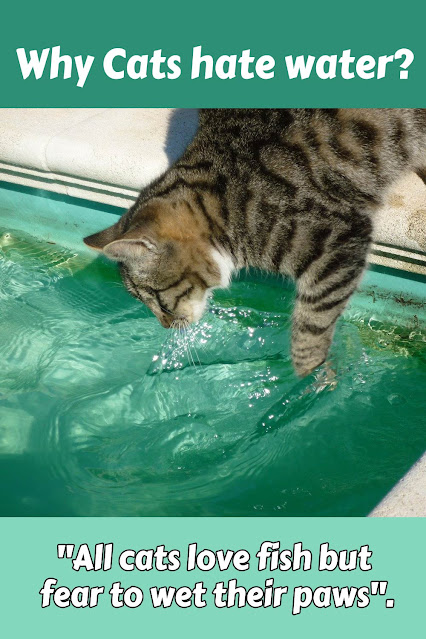
An old Chinese proverb says "All cats love fish but fear to wet their paws". 

Even before cats became pets, bathing or swimming in nature was not a behavior that was beneficial for cats. On the contrary: wet fur even gives cats several disadvantages.

Cat in front of pool


Photo: Pixabay.com

1 - Cats use their sense of smell to orientate themselves strongly. A wet fur disturbs this and so restricts the orientation.

2 - Cats protect their fur from water. If their thick fur gets wet, the weight increases, which means that the cat is severely disturbed in its balance and flexibility and that it is hindered in the event of a possible escape from danger.

3 - Cats are very clean animals and spend several hours a day grooming their fur. If the fur gets wet, the hygiene is over.

4 - Their fur protects them from the cold. A wet fur, on the other hand, loses its insulating effect and thus also the protection against the cold. Due to the high density of hair, the fur also takes a long time to dry.

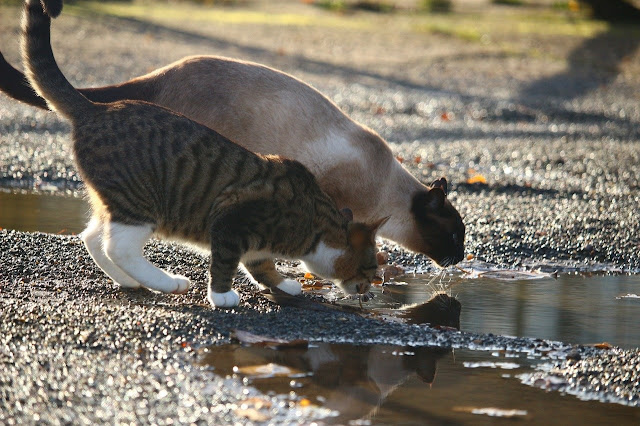
Cats drinking water

5 - Cats lose their scent through water. Thanks to intensive grooming, cats get their very own personal scent, which other cats can also perceive from a distance. Once the fur has gotten wet, it takes a long time for its own scent to restore itself.

6 - There is also the shock factor. For example, accidentally falling into a full bathtub can be a frightening experience for a cat and they may fear water for the rest of their life.

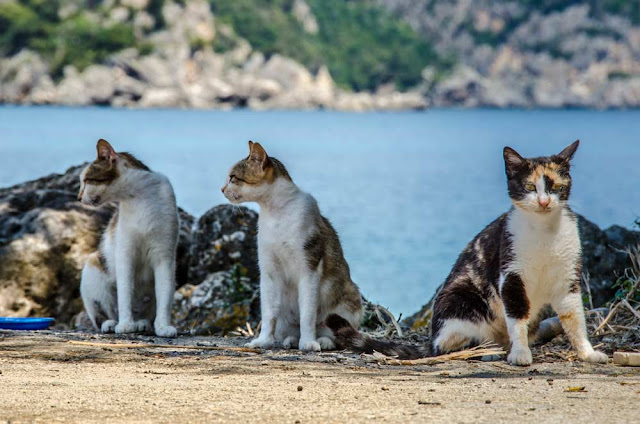
Three cats in front of sea

Do all domestic cats hate water?

An aversion to water is one of the most well-known traits of domestic cats. However, this does not apply to all cats. Certain breeds of domesticated cats, such as the Maine Coon, Bengal, and Turkish Van, are less afraid of water and occasionally swim. What makes these breeds unique is the texture of their fur, which makes them more water resistant than other breeds.


Facts on Water for Kids

Water is not only the most common substance on earth, it is also one of the most unusual.
No other substance can change its shape and form like water can.
Water is made up of tiny particles called molecules. 
A single drop of water contains millions of molecules. Each of these molecules is made up of even smaller particles. These are called atoms. Each water molecule contains atoms of two substances, hydrogen and oxygen.
Two atoms of hydrogen join with one atom of oxygen to form water. 
Scientists give hydrogen the symbol H and oxygen O. These symbols are used together to give the scientific name for water—H20.
Can you see why?
Water can exist in three states—a solid, a liquid or a gas. 
The molecules that make up liquid water are always moving freely. When water is cold, the molecules slow down. If cooled enough, water can change to ice. When rain water is frozen, it takes on other forms, such as snow, hail, or sleet.
When water is heated to a boiling state, it forms steam. The molecules move around in the air with great speed and a high level of energy.
Water will always flow to the lowest place it can reach. At the Iguagu Falls, on the border of Brazil and Argentina, the waterfalls more than 231 feet (70 meters).

When water freezes, the molecules slow down and form a regular pattern. Snowflakes such as these always have six sides, though each one is different from any other.

These icicles are solid water and very hard.
As water trickles down from the eave, it freezes into an icicle. Then as more water trickles down the icicles, it freezes and adds to the size of the icicles.

This snowman contains millions of tiny ice crystals, but most of it is air.

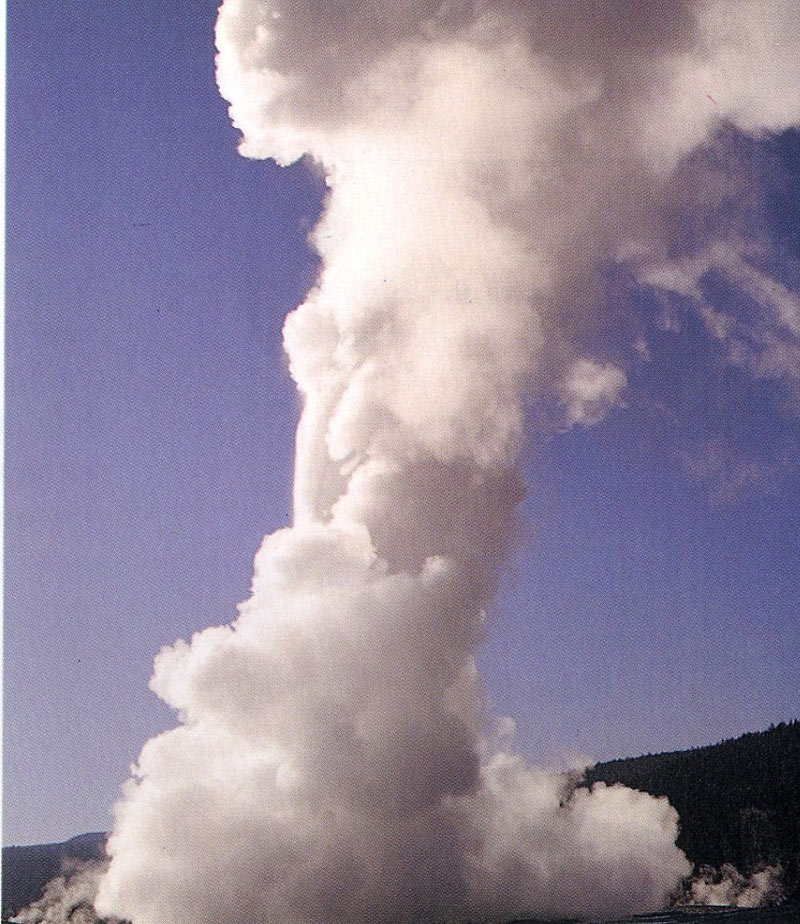
Millions of droplets of boiling water and steam from the Old Faithful geyser, in Yellowstone National Park, come from inside the earth's crust.

The tiny droplets of water in this dawn fog in the Namib Desert, in southwestern Africa, will gradually evaporate as the day becomes hotter.


What is the Recommended Daily Water Intake - Importance of Water in Our Life

What is the recommended daily water intake?

Without enough water, the human body is soon unable to go on working. 
Our blood is mostly made of water.
Blood carries oxygen from our lungs and nutrients from our intestines to all parts of our bodies. Nutrients are the useful chemicals that we take from our food.
Water also helps to keep our muscles and joints running smoothly.
Some of this water is lost because we breathe it out. In cold weather, we can see the water vapor condensing in the cold air as it comes out of our mouths.
We lose water when we perspire and when we go to the toilet.
If we are ill, we often have a fever and perspire more than usual. 
This is why, if we are ill, the doctor may tell us to drink plenty of liquids.
Did you know that you could live without water for only about a week? 
You probably think your body feels firm and solid because it's full of strong bone and muscle.
But, in fact, about 65 per cent of your body is made up of water.
Because we lose water, we need to keep replenishing the water in our bodies.
We need about 2.5 quarts (2.4 liters) of water each day.

Fun Facts About Water for Kids

Did you know that nearly three-quarters of the surface of the earth is covered with water? 
There are vast oceans like the Atlantic and the Pacific, and smaller seas like the South China Sea and the Red Sea.
There are lakes, rivers and streams.
Around the North and South poles, frozen water forms icecaps that last all the year round.
Below ground, there is even more water. 
This has soaked down through the soil to fill the spaces between the rocks with large stores of water.
There is even water in the air. 
Clouds are made up of millions of tiny droplets of water. Clear skies contain moisture which moves around in the air as an invisible gas.
Water is different from every other substance on earth because it can be found in its natural state in three different forms.

  • When we speak of water, we usually mean water as a liquid. 
  • When water is solid, we call it ice. 
  • When it is a gas, we call it water vapor.

Water can change very easily from one form to another.
Heat from the sun makes liquid water change to water vapor.
When the water vapor cools it forms rain, which falls to the earth.
If the rain becomes very cold it can change to snow or hail.
Every living thing on the earth depends on water.
Animals need water to drink.
They may eat other animals or plants, and these also need water to survive and grow.
Even plants and animals that live in desert regions, where rain rarely falls, need the tiny amounts of water vapor in the atmosphere to survive.

How to Soften Hard Water?

Do you live in a place where the water is "hard"?  
It is easy to tell if you do, because a chalky layer, or scale, will usually build up inside your kettle.
This layer is often called lime or limescale.
Scientists call it calcium carbonate. 
It is left on the inside of the kettle when some types of hard water are boiled.
Water becomes hard when it soaks through chalk, limestone or dolomite rocks.
These are all relatively soft rocks, some of whose chemicals dissolve in the water.
When water is boiled, the dissolved substances change, leaving the solid calcium carbonate behind.

In many ways, hard water is a nuisance.
When you wash in hard water, it is difficult to work soap into a lather.
Instead, the soap makes an unpleasant layer of scum on the surface of the water.
Because hard water contains harmful minerals, it can also do harm to hot-water systems.
Unless special chemicals are added to the water, scale builds up in the hot-water tanks and pipes just as it does inside a kettle. In time, the hot-water pipes may become blocked.

How to soften hard water?

One simple way of making hard water softer is to add a small amount of washing soda.
The chemical name for washing soda is sodium carbonate.
It removes the minerals that make the water hard. This stops a film of scum from forming and allows lather to form in the water when soap is added.
One simple way of making hard water softer is to add a small amount of washing soda.
The chemical name for washing soda is sodium carbonate.
It removes the minerals that make the water hard.
This stops a film of scum from forming and allows lather to form in the water when soap is added.

How to test for hard water - Home test

Find out if you live in a hard or soft water area.
You will need:
a bowl of water soap
washing soda a spoon
1. Run some water into the bowl and wash your hands using soap.
Did it make plenty of lather quickly? 
If so, your water supply is soft.
2. If the soap left a film of scum on your hands instead of working into a lather, empty and rinse the bowl and refill it.
Add one spoonful of washing soda and stir with the spoon until it dissolves.
Now take the soap and wash your hands again.

Why is the Sea Salty?

Put two or three pinches of table salt into half a glass of water and stir the water with a spoon.
What happens?
The salt seems to disappear.
In fact, it is still there, but it has dissolved in the water.
The salt and water have formed a solution. Each grain of salt is a crystal. This is a group of particles arranged in a regular pattern. Water molecules break the crystals up into individual salt particles, which are too small to be seen. This is why the salt seems to disappear.
Most of the earth's surface is covered with a solution.
We call this solution sea water.
There are many things dissolved in it, but the most common substance is a chemical called sodium chloride.
We know it better as table salt.
It makes the sea taste salty.
You may think the salt has disappeared. But taste the water and you will find the salt is still there. You cannot see it because it has dissolved.
Some of our salt comes from the sea. First, sea water is allowed to flow into large shallow pools.
The heat of the sun evaporates the water, leaving the salt behind.
Substances which dissolve in water are described as soluble substances.
We can make soluble substances dissolve faster by stirring, shaking or warming them.

What would happen if you continued to put more salt into the water? 

After a time, no more would dissolve, however much you stirred it, shook it or warmed it. The solution would be saturated. A saturated solution cannot hold any more of a soluble substance.

What is Hot Water Heating?

Hot water or steam in pipes is a convenient way of moving heat around buildings. This is what some central heating systems do. The water is heated up in a boiler and pumped through pipes to radiators in each room. Heat travels from the water into the metal of the radiators. Moving heat from one object to another in this way is called conduction.
Now the heat travels from the radiators to warm the air in the room.
It does this in two ways.
One is by a movement called convection. The radiator heats the air around it. The heated air rises and cool air rushes in to take its place. The hot air moves along the ceiling away from the radiator pushing cooler air in front of it. This convection current moves down the wall opposite the radiator, along the floor and so back to the radiator again.
The other way a radiator works is by sending out waves of heat in the same way as the sun. This is called radiant heat.


Hot air from the radiator moves around the room. The heat is gradually lost to the cool air by conduction.

Why do Boats Float on Water?

Why do Boats Float on Water - Do you know why some things float while others sink? It isn't just because of their size or their weight. If you can float when you go swimming, why does a small pebble sink? The answer is that floating or sinking depends on an object's density. If an object is more dense than water, it sinks. If it is less dense than water, it floats.
An object is more dense than water if it weighs more than the same amount, or volume, of water, Pebbles are made of gritty particles, which are very heavy and packed together tightly. This is why they sink. They are more dense than water.
Steel has a higher density than water, so why doesn't a steel boat sink? The answer is that the inside of a ship is hollow and contains air. It also contains other materials which are less dense than water. The density of the whole ship is less than that of water.

Desalination for Kids - What is Desalination?

Have you ever swum in the sea and accidentally swallowed some sea water?
It probably made you gag and cough. Sea water contains a lot of salt and this makes it very unpleasant to taste, as well as unhealthy to drink.
If you were to drink salt water, you would become thirsty.
Do you know why?
You already have lots of salt in your body— everybody has!
If you take in even more, you would feel the need to drink some liquid to water down, or dilute, the extra salt.
We can make good use of both the water and the salt in the sea, but we need to separate them first.

People in some countries in the world are so short of fresh water that they are even thinking about towing icebergs from Arctic regions to their own dry lands!
Ninety-seven per cent of the world's water is found in the oceans and seas.
Fresh water can be made by taking salt out of sea water.

Desalination process

This process, called desalination, is expensive because it needs large amounts of energy, and the salt wears away the equipment.
Saudi Arabia produces over 442 million gallons (1.7 billion liters) of fresh water each day by desalination.
In the desalination process, the salt water is boiled and quickly turned into steam. The steam then condenses into fresh water.

CAUSES OF RIVER POLLUTION

Is there a river near where you live? Many cities, towns, and villages are built beside rivers. Rivers provide us with water for drinking and cooking and for growing crops. Often, our rivers are waterways that can ferry us from place to place. But we also use our rivers to carry away waste to the sea. Many of these rivers are becoming polluted.

WHAT CAUSES RIVER POLLUTION?

Most river pollution comes from industry. Acid rain, caused by gases from factory chimneys, falls into lakes and streams. Chemical waste from factories and warm water from power stations may be pumped straight into the river. Some waste chemicals are poisonous to the plants and animals of the river, and warm water kills animals living at low temperatures. Nitrates, often found in fertilizers, may drain through the soil and pollute streams and rivers.
Human waste, called sewage, is sometimes poured into the river. Sewage, together with other waste, decays in the water, using up valuable oxygen. Fish and other river life need oxygen to breathe. Some rivers are now so starved of oxygen that no plants or animals can survive in them. Modern sewage treatment plants help reduce the problem.

EFFECTS OF WATER POLLUTION

River pollution is a serious problem in some countries. People bathe and wash in the rivers. Animals drink water from the rivers. Polluted water contains bacteria, chemicals, or other substances that can cause illness or death.
Many efforts are being made to save our rivers, bays, and lakes. And some have been saved. If we find better ways to get rid of sewage and cut down industrial waste, we may be able to save the life in other lakes and rivers and keep the water clean.

CAUSES OF WATER POLLUTION

This river is clean when it starts its journey to the sea. Many plants and fish live in the water.
1. Rain clouds carry acid rain from the towns on the other side of the mountains. The acid rain falls in the streams that feed the river.
2. The river passes a farm where chemicals are washed into it by the rain.
3. Farther on, the river passes a town where it is polluted with chemicals from factories.
4. Then sewage enters the river and decays. Foam comes from detergents which the sewage system has been unable to break down.
5. By this time, all the fish have been poisoned. There are no plants on the river bank either.
6. People see that the river is a dump and throw even more garbage into it.
7. By the time the water reaches the sea, it’s in a terrible mess!

HOW DOES TIDAL POWER WORK?

Have you ever watched the sea during a storm?
The waves crash down with enormous energy. Sometimes they are strong enough to damage seaside walls and buildings, or even make cliffs crumble.
Do you know how we can make use of energy from the waves?
One idea is to place a line of rafts floating on the sea. These rafts move up and down with the waves, and their kinetic energy can be converted to electricity. One type of raft is the Salter duck, named after its British inventor, Stephen Salter. Salter ducks bob up and down as the waves pass by. Their movement produces energy that pumps water through a turbine, which then turns a generator.

As the tide water flows out, it passes through turbines to generate electricity. There are few large tidal power stations because they are expensive to build.

The energy in the sea’s tides, which rise and fall every day, can be converted to hydroelectric power. When the tide comes in, the water is stored behind a dam. When the tide goes out, the water flows from the dam through a turbine and produces electricity. There are tidal power stations in northern France, on the Annapolis River in the Canadian province of Nova Scotia, and at Murmansk in Russia.

How Do Hydroelectric Power Stations Work?

Hydroelectric power stations generate electricity by using the energy of moving water. They are one of the oldest and most widely used forms of renewable electricity generation.

The basic process is simple:

Water → Turbine → Generator → Electricity

But how does this actually happen?

How Do Hydroelectric Power Stations Work?

💧 The Basic Idea

A hydroelectric power station takes advantage of the fact that water stored at a height has gravitational potential energy.

When the water is released and flows downhill, this energy is converted into the energy of moving water. The moving water spins a turbine, and the turbine drives a generator that produces electricity.

The electricity is then sent through transformers and transmission lines to homes, businesses, and other users.


🏗️ Inside a Hydroelectric Power Station

A typical dam-based hydroelectric station has several important parts.

1. Reservoir

A reservoir is the large body of water stored behind a dam.

Because the water is held at a higher elevation than the power station, it contains gravitational potential energy.

Higher water level = greater potential energy.


2. Intake

The intake is the controlled opening where water enters the power station's water-conveyance system.

Gates can be used to control how much water flows toward the turbine.


3. Penstock

The penstock is a large pipe or passage that carries water from the reservoir toward the turbine.

As the water travels downhill, gravitational potential energy is converted into kinetic energy.

Stored water → fast-moving water


4. Turbine

The moving water strikes or flows through the blades of a turbine, causing it to rotate.

The turbine converts the energy of the moving water into mechanical energy — rotational motion.

Different hydroelectric stations use different turbine designs depending on factors such as water flow and height difference.


5. Generator

The turbine is connected to a generator by a shaft.

As the turbine spins, it turns components inside the generator. Electromagnetic processes then convert the mechanical energy of rotation into electrical energy.

This is the crucial step:

Mechanical energy → Electrical energy


6. Transformer

The electricity produced by the generator is passed through a transformer.

The transformer increases the voltage so that electricity can be transmitted efficiently over long distances.

It then travels through the electricity transmission network toward where it is needed.


7. Outflow

After passing through the turbine, the water is released back into the river downstream.

The water is not used up to generate the electricity. It continues through the natural water cycle.


⚡ The Energy Transformation

One of the most important things to understand is the sequence of energy changes.

The complete chain:

Gravitational potential energy
↓
Kinetic energy
↓
Mechanical energy
↓
Electrical energy

In other words:

Water stored high above the turbine has potential energy. As it falls, that energy becomes movement. The movement spins a turbine, which drives a generator and produces electricity.


📏 What Determines How Much Electricity Is Produced?

Two major factors are particularly important.

1. Head

Head is the vertical height difference between the upstream water level and the turbine/outflow level.

A greater height difference means the water can release more gravitational potential energy.

2. Water Flow

The amount of water flowing through the turbine also affects how much electricity can be generated.

Generally:

More head + more water flow → greater power-generation potential

The efficiency of the turbine and generator also affects the amount of electricity ultimately produced.


🌊 What Happens When There Is Too Much Water?

Dams commonly include a spillway.

During periods of heavy rainfall or high inflows, the reservoir can rise significantly. A spillway provides a controlled route for excess water to pass around or over the dam safely.

This helps protect the dam from water levels becoming dangerously high.


🌱 Advantages of Hydroelectric Power

Hydroelectricity has several important characteristics.

♻️ Renewable

It uses water, which is continually replenished through the water cycle.

🌫️ Low Direct Greenhouse-Gas Emissions

Hydroelectric power stations do not burn fossil fuels while generating electricity.

⚡ Reliable and Controllable

Many reservoir-based stations can adjust electricity production by controlling water flow through their turbines.

🏭 Long Operating Life

Large hydroelectric infrastructure can operate for many decades when properly maintained.


⚠️ Disadvantages and Environmental Effects

Hydroelectric power also has environmental and social impacts.

🐟 Ecosystems

Dams can change river habitats and interfere with fish migration.

🌳 Flooded Land

Large reservoirs can cover areas of land that previously contained forests, farmland, or settlements.

🌧️ Dependence on Water

Electricity production depends on available water. Droughts and changes in rainfall can reduce reservoir levels and generation.

💰 High Construction Costs

Large dams and power stations can require substantial investment and take many years to construct.


🔄 Different Types of Hydroelectric Power Stations

Not every hydroelectric station uses a huge reservoir.

Reservoir Hydroelectric

A dam stores a large quantity of water. Operators can control the flow through the turbines.

Run-of-River

A run-of-river station uses the natural flow of a river with little or no large storage reservoir.

Pumped Storage

Pumped-storage facilities use electricity to pump water uphill into a reservoir when demand is low. Later, the water can flow downhill through turbines to generate electricity when demand is high.

Pumped storage is particularly useful for storing electrical energy.


🧠 Remember It in Seven Steps

If you need to remember the process for an exam, use:

STORE → RELEASE → FLOW → SPIN → GENERATE → TRANSFORM → TRANSMIT

STORE — Water is stored behind the dam.
RELEASE — Gates control the water entering the system.
FLOW — Water travels rapidly downhill through the penstock.
SPIN — Moving water rotates the turbine.
GENERATE — The turbine drives the generator.
TRANSFORM — A transformer increases the voltage.
TRANSMIT — Electricity travels through the grid.


📝 Quick Revision

ComponentMain function
DamHolds back and stores water
ReservoirStores water at a higher elevation
IntakeControls water entering the system
PenstockCarries water toward the turbine
TurbineConverts water movement into rotation
GeneratorConverts rotation into electricity
TransformerChanges voltage for transmission
Transmission linesCarry electricity over long distances
SpillwayReleases excess water safely
OutflowReturns water to the river

🎯 The One-Sentence Answer

A hydroelectric power station uses the energy of falling or flowing water to spin a turbine connected to a generator, converting the water's energy into electricity.

The easiest way to picture it:

🏞️ High water
↓
💧 Falling water
↓
🌀 Spinning turbine
↓
⚡ Generator
↓
🔌 Electricity
↓
🏠 Homes & businesses

Water provides the movement. The turbine provides the rotation. The generator produces the electricity.


🎓 Student-Friendly Learning Summary

What should I remember?

A hydroelectric power station uses moving water to generate electricity.

💡 The process

1. Water is stored 🏞️
A dam holds water in a reservoir high above the power station.

2. Water flows downhill 💧
The water is released through an intake and travels down a penstock.

3. The turbine spins 🌀
The moving water pushes the turbine blades and makes the turbine rotate.

4. The generator produces electricity ⚡
The rotating turbine turns a generator, which converts mechanical energy into electrical energy.

5. Voltage is increased 🔌
A transformer increases the voltage so electricity can travel efficiently through transmission lines.

6. Water returns to the river 🌊
After passing through the turbine, the water flows downstream.


🧠 Energy Transformation

Remember this sequence:

Potential energy → Kinetic energy → Mechanical energy → Electrical energy

Think of it as:

Water stored high → water moving → turbine spinning → electricity


⭐ Three Things to Know for an Exam

1. What makes the turbine spin?

Moving water.

2. What produces the electricity?

The generator.

3. What affects how much electricity can be generated?

Mainly water flow and height difference (head), along with the efficiency of the equipment.


🔑 Memory Trick

STORE → FLOW → SPIN → GENERATE → TRANSMIT

STORE water
→ FLOW downhill
→ SPIN the turbine
→ GENERATE electricity
→ TRANSMIT it to users


✏️ Test Yourself

Q: Why is water stored high behind a dam?
A: To give the water gravitational potential energy.

Q: What does the turbine do?
A: It converts the energy of moving water into rotational mechanical energy.

Q: What does the generator do?
A: It converts mechanical energy into electrical energy.

Q: Where does the water go after the turbine?
A: It flows back into the river downstream.

Q: Does the hydroelectric station use up the water?
A: No. The water continues downstream and remains part of the water cycle.


🎯 One-line takeaway

A hydroelectric power station turns the energy of falling or flowing water into electricity.


Don't miss:

What is Osmosis?

When we feel thirsty we have a drink.
We take water into our bodies by swallowing it.
Plants don't swallow.
So how do they take in water?
On a plant's roots, there are tiny growths called root hairs. Plants take in water and nutrients through their root hairs, using a process called osmosis.
Osmosis is the movement of liquid from one solution into another through a membrane that separates them. A solution is a mixture of a liquid and some dissolved substances. A membrane is a thin "skin" that allows some substances, but not others, to pass through.
During osmosis, water containing nutrients moves from the soil, through membranes covering the root hairs, and into the roots. The membranes allow the water to seep into the root hairs, and also prevent nutrient-rich liquid from leaving the roots.

This close-up photo shows the tiny root hairs very clearly. Water moves through the membrane covering the root hairs, by osmosis, and into the root.

Water enters the plant through its root hairs.
In plants the food is made into the leaves, from where it travels to other parts, such as the stems and roots. Plants have a juice inside them called sap. The sap is like the blood of the plant. In many plants, it flows through special tubes, called phloem, which carry the sugars to all the plant's cells.

If you cut off the stem of some plants, such as the sugar cane, you will see a drop of sap forming at the cut end. This sap contains sugars which feed the plant, and we can use it to make sugar. Some plants contain other liquids, which we can use. We can make rubber out of the milky liquid that oozes out of rubber trees.


When does osmosis work?
You can find out in this experiment, using any root vegetable, such as a potato or a yam.

Growing Seeds - Water for growth

When you look at some flower seeds, it's often hard to imagine that they can grow into the lovely flowers in the picture on the packet. Seeds look as if they have no life in them at all.
However, seeds have all the food they need to start growing. So why don't they grow inside their packet? Seeds need three other things to begin growing. They need oxygen, warmth and water. If they have these three things, the seeds start growing. They use the nutrients stored inside them, the water they absorb from the soil, and the oxygen they take from the air. Some seeds stay dormant up to 50 years before they start growing, and then only if the conditions for growth are right.
There is only a small amount of nutrients inside each seed. When this is all used up, plants must make their own food.

Plants get their food from the soil. They soak up water from the soil, through their roots. This water has nutrients dissolved in it. Not all soil contains the nutrients that plants need. Sometimes a farmer or gardener has to add these nutrients to the soil in the form of fertilizers. These are washed into the soil by the rain, and the fertilizers are picked up by the plant's roots in the same way as if they were natural nutrients.
Farmers spread fertilizer on their land to put more nutrients into the soil. Then they can grow healthier crops.

Water Evaporation and Condensation

Water is constantly on the move, whether in the oceans and rivers, in a pond that looks completely still, or in a glass of water. Water molecules move about at different speeds all the time. If they move fast enough, some break away from the surface and enter the air. This is called evaporation. Some of the molecules then fall back into the water. But others become water vapor and are carried away by air currents. In this way some of the water is gradually lost to the atmosphere.
You can see this happen if you leave a saucer of water uncovered indoors. After a time, there will be no water left. It will all have evaporated.
Wet laundry on a clothesline dries more quickly in a breeze. The wind carries away the water molecules soon after they enter the air from the washing. Hardly any of them fall back on the clothes.

When water is heated, all of its molecules speed up and more of them escape. If water is made hot enough, all the molecules eventually escape and the water boils away. All of it becomes water vapor.
Heat speeds up evaporation. Cold slows it down and may even stop it, turning the water vapor back into water droplets. This process is called condensation. When you take a hot bath, molecules from the bathwater escape into the air and become water vapor. Some of them touch the cold bathroom walls and windows, and this cools them down and turns them back into drops of water. The walls, windows and the bathroom mirror become misty.
The insides of windows sometimes become misty on rainy days for the same reason. Inside a warm room, molecules of water vapor are moving about. Some of them meet the glass of the windows, which the rain has cooled. The loss of heat turns the water vapor near the glass back into water. If it gets cold enough at night, the water on the window will freeze and you may wake up to find your windows are frosty on the inside.
These wet clothes will dry faster when the wind is blowing. The water molecules evaporate into the air, and are blown away by the wind.
 
When water is cold, very few molecules will evaporate.
When water is warmed, the water molecules will escape more quickly from the surface into the air.