Why are metals good conductors of heat and electricity?

Thermal conduction is a type of heat transfer in which heat is transferred through the body from areas of higher temperature to areas of lower temperature. The thermal conductivity of substances is different. There are good and bad conductors of heat.

Metals are good conductors of heat.

Heat conduction takes place in a body only when areas of different temperatures are present. The heat is always transferred from areas of higher temperature to areas of lower temperature. If a body is left to its own, the temperature will gradually equalize. The heat transmitted through a body depends of the:  

  • Substance of which the body is made,
  • The cross-sectional area of the body,
  • Temperature difference,
  • Length (dimensions) of the body,
  • Time.

The thermal conductivity is a material constant. Depending on the value of these material constants, a distinction is made between good and bad heat conductors.


All metals, especially silver, copper, gold and aluminum, are good heat conductors. 

Almost all plastics, wood, water, glass and, above all, air are poor heat conductors. 

Water is a poor conductor of heat.

Heat conduction can also take place from one substance to another. The heat then passes from one substance to another. This is known as heat transfer. Heat is transferred, for example, from the surface of an immersion heater to the surrounding water. Another example is the transfer of heat from the bottom of a saucepan to the food in it.

  • Have you ever taken a spoon out of a mug of hot cocoa or tea or some other hot drink?
  • Did you find that the spoon was too hot to hold, so that you had to drop it?
  • Did you burn your fingers?

If you have never done this, don’t try it now.

But if you have done this, then you found out the hard way that heat can travel through some solid materials, such as metals. When heat travels in this way, we say that the heat is conducted. In the hot drink, the heat is conducted from the liquid into the metal spoon.

  • Why was the handle of the spoon so hot?

Atoms in the bowl of the spoon move faster and bump harder into each other as they heat up. The faster the atoms vibrate the hotter the spoon becomes. The atoms in the lower part of the spoon then bump into the metal atoms a little farther up the spoon. These atoms then bump against their neighbors even farther up and start them vibrating. Soon, all the atoms in the spoon are vibrating faster.

When the handle of the spoon is cold, the atoms in the metal vibrate slowly.


Why do metals conduct heat and electricity so well?

Metals are the best conductors of heat and electricity because they contain an abundance of free electrons. It is known that the positive nucleus binds the negative electrons to the atom. The force with which this is achieved is called Coulomb force.

The Coulomb force becomes weaker with increasing distance.

Thus we can conclude that the force that the electrons occupy increases when the closings become weaker, and of course weakest when the electrons are drawn into the outermost or so-called valence shell.


These electrons are so weakly attracted that they manage to escape and free themselves from the atom.

They are therefore called free electrons.

What is responsible for a metal's tendency to lose its valence electrons is its large atomic size and its own lack of valence electrons.  Each metal atom produces one or two free electrons, and a piece of any metal contains a huge number of atoms. Sheet metal is full of free electrons, and it is these free electrons that propagate heat and the current flowing through it.

How Free Electrons Propagate Electricity and Heat

For example, if we connect a copper wire to a battery, the positive pole attracts the negative free electrons. The sudden force exerted by the electric field makes them spin and crash violently at tremendous speed. A domino effect follows.

In the same way, heat is conducted through a metal. A source of thermal energy is nothing more than a source of kinetic energy. When we apply a source of heat to a material, it transfers kinetic energy to the atoms of the material. This kinetic energy energetically puts the atoms in their place. The higher the heat, the stronger the tremor.

Ionic compounds also conduct heat when ions wobble in their positions. Ionic compounds, however, are characterized by a highly symmetrical geometric arrangement or structure. They wobble, but their movement is severely limited by this structure.

Pure metals, on the other hand, are superlative conductors because their atoms are restricted by their structure, but their electrons are not. They are free. The electrons move randomly when the source gives them kinetic energy. They then collide with neighbouring electrons and transfer their kinetic energy during the process. Collisions emulate a domino effect and heat is transferred from the hot area, the area closest to the source, to the cold area.


Electrical Circuits for Kids - What is Electric Circuit?


  • Do you have a flashlight? 
  • Have you ever looked inside it? 

A flashlight won't light up unless there are batteries inside.
When you switch it on, the batteries make an electric current flow.
This current flows through the bulb and makes it light up.
When you switch on a flashlight, the batteries inside create an electric current by making electrons move. The electric current flows out of one end of the battery, through the bulb, and then back into the battery.
As long as the current can move freely around this pathway, the bulb will light up.
We call this kind of pathway an electric circuit.
While the flashlight is switched on, the current continues to flow around and around the circuit. Turning the switch off makes a break in the circuit. Now the current can't flow, and the light goes out.

Electric Circuit experiment

You will need:

  • two pieces of plastic-coated wire, about 8 inches (20 cm) long, with bare ends
  • a screwdriver 
  • masking tape 
  • a 1.5-volt("D") battery
  • a 1.5 volt battery bulb holder

Which bulb will light up?
An electric current won't flow if it can't make a complete trip around a circuit.
You can test this for yourself.
Set up the simple circuits shown below.
Can you guess which one will make the bulb light up?

1. Tape one end of a piece of wire to the top battery terminal.
Connect the other end of this wire to one side of the bulb holder.
Does the bulb light up?
Electric Circuit experiment for kids Part 1

2. Now connect the other circuits shown here.
Electric Circuit experiment for kids Part 2

Which one is a complete circuit?

Positive and negative terminals

A battery has two connections where the electric current flows in or out.
These connections are called terminals.
Sometimes, as in most flashlight batteries, the terminals are on either end of the battery. Other batteries have both terminals on one end.

  • One terminal is marked + (plus). 
  • The other terminal is marked — (minus). 

The electric current flows out of the terminal marked plus, the positive terminal.
The current flows into the terminal marked minus, the negative terminal.

Thunderstorms for Kids - What are Thunderstorms?

Despite their dramatic behavior, thunderstorms are the smallest of the different kinds of storms.
They average around 16 km (10 mi) across, but they often occur in lines that can be a few hundred miles long or clusters a couple hundred miles across.
Thunderstorms are often part of larger storms such as hurricanes.
While thunderstorms occur most commonly in warm weather, they can happen in the winter.
Sometimes snow will fall from a thunderstorm instead of rain; this is called a “thunder snow.”

Every thunderstorm includes lightning because lightning causes thunder.
Lightning creates a danger in any thunderstorm, no matter how large or small.
Many thunderstorms drench the countryside with heavy rain, so you also have to worry about flash floods—that is, floods that rise very quickly, sometimes running over the banks of normally small streams.
If a thunderstorm is strong enough, it can also create hail, or balls of ice that fall from the storm.
Hailstones are usually less than 1.3 cm (0.5 in) across.
Occasionally hailstones as big as softballs fall during storms, posing considerable danger because such large stones fall faster than 160 km/h (100 mph).
Some especially dangerous thunderstorms create winds called downbursts, which descend from the clouds and hit the ground going faster than 160 km/h (100 mph).
Downbursts are sometimes concentrated in small areas less than 4 km (2.5 mi) across called microbursts. Thunderstorms also sometimes create tornadoes in the warm air that’s rising from the ground.
Unlike microbursts, tornado winds spin in a circle as the air rises.
Tornado winds can blow faster than 400 km/h (250 mph), but twisters this strong are rare.

Where Does Our Electricity Come From?

Have you ever stood outside during a bad storm and seen a sudden flash light up the sky? 
That was probably lightning.
Lightning is very powerful.
The heat from a flash of lightning can burn the ground and even set trees or houses on fire.
Do you know what lightning is? 
Lightning is a giant spark of electricity in the air.
Have you ever noticed tiny sparks when you comb your hair, or when you take off a sweater very quickly in the dark?
These are sparks of electricity. They are just like lightning flashes, but much smaller and safer.
Our body uses electricity all the time. 
Our heart produces tiny amounts of electricity to help it beat properly. Our brain is receiving and sending electrical messages to every part of your body, even when you're asleep.
All animals' bodies produce electricity, and some even use it as a weapon. 
Have you ever heard of the electric eel? 
The electric eel lives mainly in the Amazon and Orinoco rivers of South America. This eel is a fish that makes its own electricity to help in catching food and in protecting itself against enemies.
The eel's body can make enough electricity to kill a small fish or to stun a human being.
We don't use electric eels to light up bulbs!
Most of the electricity, or electric current, we use comes from huge power stations.

Can you think of some ways that we use electricity?


  • Electricity lights up bulbs so that we can see at night.
  • Electricity heats up ovens so that we can cook food.
  • Electricity helps to carry our voices along the wires when we speak to people on the telephone.
  • Electric trains quickly take people from one place to another.
  • Electricity makes it possible for computers to do complicated calculations.
  • Electricity lights up the whole of the city at night.


Electricity for Kids - What is a Transformer?

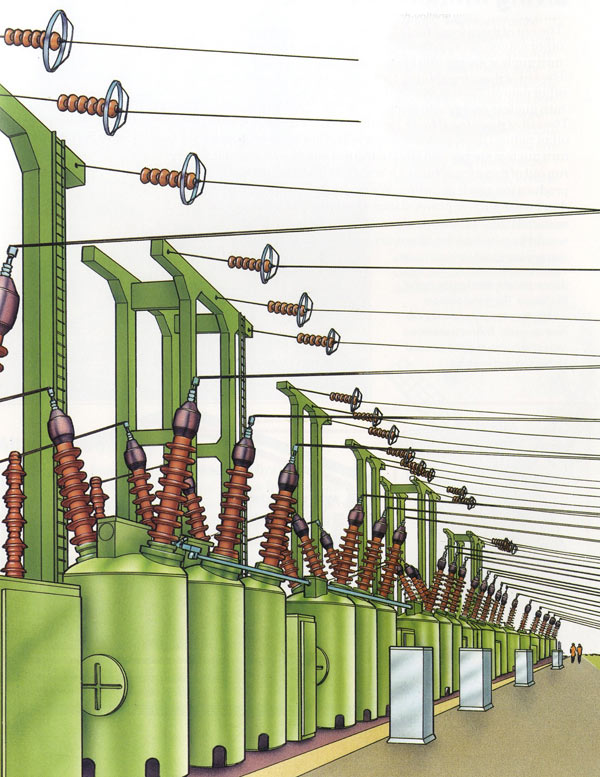
A transformer can make an electric current smaller or larger. As an electric current flows along the wires from a power station, it loses energy. A large current loses much more energy than a small current.
So power stations use transformers to reduce the current. Transformers do this by increasing the voltage. When the voltage is increased, the current becomes smaller. A transformer that increases the voltage is called a step-up transformer.
Many household appliances, such as radios and battery chargers, also use transformers. The voltage these appliances need is lower than the voltage of the electricity in your home. A transformer that reduces the voltage is called a step-down transformer.
Alternating current passes through the first coil in this step-up transformer. This makes an electric current flow in the second coil, which has more turns of wire. The voltage of the second coil is higher than the voltage of the first coil.

How do transformers work?

A transformer contains an iron core with two coils of wire wrapped around it. These two coils of wire have a different number of turns. Alternating current flows separately through each coil. In a step-up transformer, the second coil has more turns of wire than the first coil. The voltage of the second coil is then higher than the voltage of the first coil.
In a step-down transformer, the second coil has fewer turns of wire. The voltage of the second coil is then lower than the voltage of the first coil.

You can see a row of transformers at most power stations. At the top of each transformer there are round insulators. They prevent sparks of electricity from jumping between the high-voltage wires and causing a short circuit.

Electricity for Kids - What Does Voltage Mean?


You can make a bulb light up by using two wires to join it to a battery. 
The bulb lights up because an electric current is flowing through it. 
The battery produces the current by pushing electrons along the wires. 
The stronger the push, the more electrons flow along the wire each second. 
The current heats the thin wire inside the bulb and makes it glow brightly.

The force of this push is measured in volts. 

The word volts comes from the name of the Italian who invented the first battery—Alessandro Volta. 
The more volts a battery has, the stronger its push.
In a copper wire (A), some electrons move freely in all directions.
When a battery is connected to the wire (B), the battery pushes the electrons in the same direction.
An electric current can now flow along the wire.
When we do experiments with electricity, we use small batteries.
These batteries give a push of 1.5, 6.0, or 9.0 volts.
We describe this as the voltage of the battery.
This voltage is printed on the side of the battery.
The voltage of the power line to your home is much higher.
The voltage of the electricity flowing through the wires in most homes is at least 110 volts and may be as high as 220 or 240 volts.
A voltage of more than 100 volts is enough to push electrons through your body.
If a strong electric current passes through your body, the shock will hurt you badly and could easily kill you. So you must always use low-voltage batteries for your electrical experiments.

Electricity for Kids - What is Electric Wire?

Do you know how water gets to the faucets on your kitchen sink?
It comes through pipes.
Pipes let water flow in the direction we want it to go.
How do we make electricity flow in the direction we want it to go? 
The electrical energy we call "electricity" is made in huge power stations.
What connects the electric sockets in your home with the power station?
The answer is wires. 
Wires are the "pipes" of the electricity system.
A wire is a long, thin piece of metal. It may be a single strand of metal, or it may be two or more strands twisted together. Some wires are thick and stiff, and others are thin and bend easily.
Why are electric wires covered?
A material that allows electricity to flow through it is called a conductor. Metals are good conductors. Some metals are better conductors than others. Silver is the best conductor of all, but it is too expensive to use to make wires. Copper is also a very good conductor and much cheaper to use than silver. So most of the wires that we use to conduct electricity are copper wires.
But it's best not to try to conduct electricity along a bare wire. When a current is flowing through a bare wire, it will also flow through any metal object or other conductor that touches the wire. Even the human body can conduct electricity. If a person standing on the ground touches a bare wire which is connected to a power line, an electric current will flow through the person and into the ground. The person may receive a dangerous electric shock and might even be killed.
We need to make sure that electric current goes just where we want it and nowhere else. So the wires used to carry electricity are covered with materials that are poor conductors of electricity. Rubber and plastic conduct electricity poorly. They are both good insulators. A bare wire that is covered with rubber or plastic is called an insulated wire, or cable.

If cable is used for the circuit wires, there are three wires inside the cable. Two of these wires carry the electric current to and from the fuse box. One is a black, red, or blue wire and the other a white wire. The third wire, which can be bare or green, is called the ground wire. It may be connected to the main water pipe. If there is a fault in the wiring, the ground wire takes the current safely away into the ground.

What is Electrical Charge and Where Does Lightning Come From?

There are two kinds of electrical charge—positive and negative. 
An object that gains electrons has a negative charge.
An object that loses electrons has a positive charge.
Two charges of the same kind push each other apart. We say that they repel each other.
Two charges of different kinds pull each other together. We say that they attract each other.

Electron charges experiment:

You will need:

  • a strip of newspaper 12 inches (30 centimeters) x 2 inches (5 centimeters)
  • apiece of wool cloth
  • a plastic ruler

A strip of paper can show you how charges of the same kind repel each other. Try this experiment when the weather is dry and not humid.

1. Stroke the strip of newspaper about 20 times with the piece of cloth.
Electron charges experiment - Stroke the strip of newspaper about 20 times with the piece of cloth

2. Place the newspaper across a plastic ruler and lift up the ruler.
Place the newspaper across a plastic ruler and lift up the ruler.

3. What can happen?
What does happen?
Explain.

Try combing your hair quickly, and then holding the comb near your hair.
Your hair stands on end! 
When you combed your hair, electrons rubbed off the hair onto the comb.
This set up an electrical charge. The comb gained extra electrons and so had a negative charge.
Your hair lost some electrons and so had a positive charge.
Your hair rose towards the comb because the positive and negative charges attracted each other.

Where does lightning come from?

Where does lightning come from?

Lightning happens when positive and negative charges move towards each other through the air.
They make an electric current that causes a spark.
This spark is the flash of lightning you see during a storm.

Where does lightning come from - Before the storm, raindrops and ice particles inside the cloud contain equal numbers of positive and negative charges.
1. Before the storm, raindrops and ice particles inside the cloud contain equal numbers of positive and negative charges.

Where does lightning come from - As the storm begins, the rain and ice particles inside the cloud bang into each other and the charges are forced apart.
2. As the storm begins, the rain and ice particles inside the cloud bang into each other and the charges are forced apart.

Where does lightning come from - Most of the positive charges rise to the top of the cloud and most of the negative charges fall to the bottom.
3. Most of the positive charges rise to the top of the cloud and most of the negative charges fall to the bottom.

Where does lightning come from - Lightning can occurwhen the negative charges from the cloud meet positive charges rising from the ground. There are also other types of lightning.
4. Lightning can occurwhen the negative charges from the cloud meet positive charges rising from the ground. There are also other types of lightning.