Alley cropping definition - What is the benefit of alley cropping?

The land that we need for growing food is very important. We can't afford to spoil it. There are many ways in which farmers could make better use of the land and grow good crops without the help of factory-made chemicals.

If it is farmed with care, the land will go on giving us enough food to eat for thousands of years to come.

One farming method is to mix trees and crops on the same piece of land.

This is called alley cropping. 

Rows of quick-growing, deep-rooted trees are planted a few yards apart, with rows of crops such as sorghum in between.

The trees help to prevent the soil from being blown or washed away. Their leaves rot and add to the humus in the soil.
 

Humus is made from dead plant matter. Tree shoots provide animal food and fuel for cooking. The trees and the sorghum take different nutrients from the soil, so they can grow side by side.

INTENSIVE AGRICULTURE DEFINITION

Day by day, there are more and more people to be fed. Farming produces most of the food that is needed. In many parts of the world, such as the open grasslands of the United States of America, Russia, Canada, and Australia, huge areas are plowed and planted with crops, year after year. This kind of farming is called intensive agriculture.

Intensive agriculture produces huge harvests for a few years. Farmers grow the same crop every year. The crops need substances called nutrients found in the soil to grow. In time, the growing plants use up the soil’s nutrients. Fertilizers are added, but the soil still becomes worn out. Trees and hedgerows that divided the fields thin out and die. The soil is then more easily swept away by strong winds and rain.

Some pests feed on one particular crop. If the same crop is planted each year, the pests will thrive. They often carry diseases to the new crop. If different crops are planted each year, the pests are not able to feed, and the diseases begin to die out.

WHAT CAUSES GLOBAL WARMING?

The world is getting warmer.
If you enjoy warm weather, you may think this is good news—but it’s not.
Some experts say that over the last hundred years, temperatures on the earth have increased by 2.7 to 10 degrees Fahrenheit (1.5 to 5.6 degrees Celsius).
The earth’s atmosphere is warming up, just as if it was trapped inside a greenhouse. This warming process is often called the greenhouse effect.
The greenhouse effect

The panes of glass in a greenhouse let in light from the sun but trap it when it is released as heat. This makes the climate inside the greenhouse hot.
In a similar way, the earth’s atmosphere lets in sunlight and then traps the heat near the earth’s surface. This is the “greenhouse effect.

Why is the earth warming up?

More of the sun’s energy is reaching the earth’s atmosphere because the ozone layer is becoming thinner.
But there is another reason why the earth is warming up.
When we burn fuels like coal, oil, gas, or wood, carbon dioxide is released into the atmosphere. Plants use carbon dioxide to help make their food.
So tropical rain forests take in large amounts of carbon dioxide from the atmosphere, but at the same time people are cutting down vast areas of these forests.
The earth is warmed by the sun.
Most of the heat is sent back, or radiated, into the atmosphere.
Carbon dioxide in the atmosphere traps some of this heat, preventing it from escaping into space. This keeps the earth warm. But if there is too much carbon dioxide in the atmosphere, it will trap too much heat, and the earth’s atmosphere will become too hot.
As the earth’s atmosphere becomes much warmer, the ice in the Arctic and in Antarctica constantly melts. 
This raises the level of the seas all over the world. 
A rise of only a few inches could flood many coastlines. Low-lying coastal towns and cities would be endangered by floods, and so would large areas of farmland.
If the seas became warmer, the sea animals and plants would be affected. And many might not be able to survive at all. In other parts of the world, a lack of rain may mean that farmland would become too dry and dusty.
Too much carbon dioxide in the atmosphere prevents more heat than usual from escaping into space. But we still need some heat to keep us warm.

HOW IS BIOGAS MADE?

Dead animals and plants rot and decay. In swampy areas, for example, dead plants fall into the water. As they decay, they give off - gas. 

Scientists call this biogas.

Biogas comes from garbage, sewage, and manure, too.

Biogas is a source of cheap energy for many villages in China. Many vehicles are fueled by methane, a mixture of biogas and carbon dioxide.

Biogas is a valuable source of energy that is often wasted. When materials decay, the biogas mixes with carbon dioxide, forming a gas called methane. Large amounts of methane can be dangerous—a tiny spark near the gas can cause an explosion. But if methane is collected safely and stored correctly, it can provide an important source of energy.

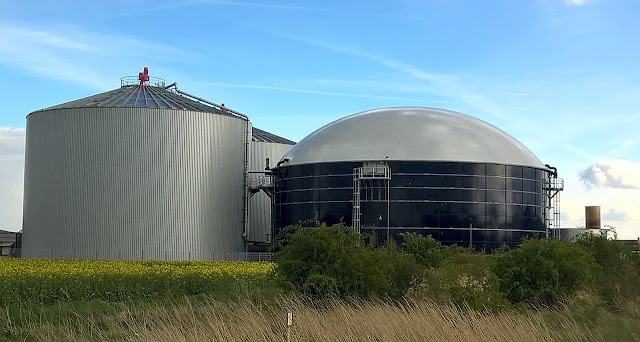
Drawing of biogas production facility at a farm

Biogas could be important in countries where other fuels are scarce or too expensive. A small village can use its own garbage and sewage to produce biogas. People collect the droppings of farm animals and put them in a tank. Some of the waste turns into liquid. 

The liquid soon starts to give off methane, which is kept in a storage tank that has an expandable lid. The gas can be used in homes for cooking and heating, or as fuel to power an engine or an electric generator.


Is biogas eco-friendly fuel?

Compared to natural gas, which is extracted by drilling in the ground, biogas is obviously a more sustainable option. Natural gas is obtained through fracking, a process in which water, chemicals, and sand are forced deep into the ground to break up rock formations. The fracking process can seriously damage ecosystems and landscapes. 

Another benefit of biogas is that it eliminates the large amounts of animal manure and food waste from the environment, and thus prevents nitrogen pollution and leakage into water resources. 

Biogas production facility


Biogas also helps reduce methane emissions that would otherwise escape from manure dumps or lagoons. Using this methane as a fuel drastically reduces its impact on the climate by converting it to CO2, which is up to 34 times less efficient than a greenhouse gas.

But in contrast to energy generation using wind power or solar energy, during biogas production, greenhouse gases are released into the atmosphere through the systems. Methane in particular can escape at various points in production. 

In addition, biogas also contains nitrogen, carbon dioxide, and nitrous oxide, among other things. The latter is only represented in small proportions but is even around 300 times as harmful as CO2. In addition, if the biogas from the plants is burned to generate energy, CO2 is produced in turn.

In addition, the transport of energy crops to the plants contributes to the negative balance of biogas.

What are the advantages of biogas?

The production of biogas brings important benefits for the environment and society :
1. Biogas is a green energy source, from which electricity and heat can be obtained.
2. Biogas is created through the fermentation of renewable raw materials, replaces fossil fuels and thus reduces greenhouse gas emissions.
3. The combustion of biogas only releases as much CO2 as the plants previously absorbed during growth. This means that biogas is one of the CO2-neutral fuels.
4. Unlike wind, water or solar energy, biogas is available without fluctuations and can be stored without any problems.
5. With biogas, organic waste from industry and households is recycled in an environmentally friendly manner.
6. Less odor nuisance when spreading liquid manure in the fields: fermented liquid manure smells considerably less than normal liquid manure and the smell wears off faster.
7. Plants absorb the fermentation substrate better than normal manure, which can increase the yield in the fields.
8. The cost of artificial fertilizers can be reduced and environmental pollution avoided.

IS GEOTHERMAL ENERGY RENEWABLE? – YES, FIND OUT WHY

The Geothermal energy is renewable, clean and sustainable energy generated from the Earth’s heat, which is constantly replenished.
At the center of the earth, it is very, very hot.
The temperature is thought to be about 13,000 °F (7000 °C), which is hot enough to melt rock.
The heat spreads to the rock around the center of the earth and to water trapped between the layers of rock. In some parts of the world, this hot water is close to the earth’s surface. By pumping it out of the ground as hot water or steam, engineers have tapped a new source of energy.
This energy is called geothermal energy, which means it is heat energy from under the ground.


HOW IS GEOTHERMAL ENERGY PRODUCED?

Do you know what it is like at the center of the earth?

It is very, very hot.
The temperature is thought to be about 13,000 °F (7000 °C), which is hot enough to melt rock.

The heat spreads to the rock around the center of the earth and to water trapped between the layers of rock. In some parts of the world, this hot water is close to the earth’s surface. By pumping it out of the ground as hot water or steam, engineers have tapped a new source of energy. This energy is called geothermal energy, which means it is heat energy from under the ground.

Tropical fruit grows in Iceland!


Hot water from inside the earth may be used directly to heat buildings. In Iceland, where there are many hot springs, hot water heats greenhouses and swimming pools as well as homes. And although Iceland is close to the Arctic Ocean, people living there can grow bananas and other tropical fruit in their greenhouses!

Steam condenses into white clouds of water vapor rising from these hot springs in Iceland. Several countries have developed geothermal power plants to heat homes and generate electricity.

In one kind of geothermal power station, cold water is pumped down a pipe into the earth and is heated     by hot rock. Another pipe brings the hot water to the surface.

Several countries in the world, including the United States, Italy, and New Zealand, have built geothermal power stations. Steam, coming out of the ground at high pressure, is used to run steam turbines that generate electricity.
Engineers are trying to find out how more countries might use geothermal energy.
They started with a question. If the rock below the surface is hot but there is no water down there, why not drill a hole through the rock, pump cold water down and let the rock heat it up? Then the water could be pumped up again through a second hole.
Some engineers are working on an even better idea. They want to build a geothermal power station underground, which would generate electricity. Then only an electric cable would be needed to bring the electrical energy to the surface of the earth.

HOW DOES TIDAL POWER WORK?

Have you ever watched the sea during a storm?
The waves crash down with enormous energy. Sometimes they are strong enough to damage seaside walls and buildings, or even make cliffs crumble.
Do you know how we can make use of energy from the waves?
One idea is to place a line of rafts floating on the sea. These rafts move up and down with the waves, and their kinetic energy can be converted to electricity. One type of raft is the Salter duck, named after its British inventor, Stephen Salter. Salter ducks bob up and down as the waves pass by. Their movement produces energy that pumps water through a turbine, which then turns a generator.

As the tide water flows out, it passes through turbines to generate electricity. There are few large tidal power stations because they are expensive to build.

The energy in the sea’s tides, which rise and fall every day, can be converted to hydroelectric power. When the tide comes in, the water is stored behind a dam. When the tide goes out, the water flows from the dam through a turbine and produces electricity. There are tidal power stations in northern France, on the Annapolis River in the Canadian province of Nova Scotia, and at Murmansk in Russia.

HOW DOES WIND POWER WORK?

The wind has been a source of energy for thousands of years.
Before the development of the steam engine, most ships relied on wind power to fill their sails and push them along. Windmills were used to turn grindstones and pump water.
Now scientists are turning to wind power again. This time they are using it to generate electricity.
Windmills have been used to produce electricity since the early 1900’s. It is easy to produce electricity from a wind turbine. This is simply a windmill that converts the kinetic energy of the wind into electricity.
Small wind turbines are used by farmers in remote parts of Australia and North America. In wide, open spaces, these turbines can make some of the electricity that farmhouses need. However, the winds are sometimes so strong that they damage the turbines and put them out of action.
Engineers have designed many different kinds of wind turbines to try to solve this problem. Some turbines look like old-fashioned windmills, with four blades, or sails. Other, more modern ones have two blades like those of an aircraft propeller.

In North America, this type of traditional windmill is used to pump water.

One of the largest wind turbines in the world stands in Hawaii, in the Pacific Ocean. It has two blades 165 feet (50 meters) long on top of a high tower. There is a smaller turbine on Orkney, off the coast of Scotland. It can generate enough electricity for about 1,000 homes. Most wind turbines are mounted on a cap, or swivel, on top of a tower. This means that they can be turned to face the wind when its direction changes.
A huge power station driven by wind has been built in the Mojave Desert in California. Its owners call it a “wind farm.”  Hundreds of wind turbines are arranged in rows and all are linked together by wires. The electricity they produce is supplied to the California power pool.
These wind turbines supply electricity to homes and factories.

HOW SOLAR POWER WORKS?

More energy reaches earth from the sun than could be converted by millions of power stations.
The sun’s energy costs nothing, but how can we use it?
We can use the sun’s energy to heat the water in our homes. One way this can be done is with a solar panel. This is a glass-topped box fixed to the roof of a building, facing the sun.

The inside of the box is painted black. Black is best at taking in, or absorbing, heat. Water flows through pipes inside the box. During daylight, this water is heated by the sun’s energy.

Heat can be produced by using mirrors to direct and concentrate the sun’s rays. One solar furnace in southern France uses a giant, curved mirror to collect sunlight from a series of smaller mirrors.
The mirror then directs the sun’s energy onto a huge furnace. A solar power station in the Mojave Desert, in the United States, uses 1,800 mirrors.
Solar cells, also known as photovoltaic cells, are made of layers of a material that produces electrical energy when light shines on it. The solar cell converts the sun’s energy into electrical energy.
Watches and calculators can be fitted with solar cells. We say that they are solar powered, although they use indoor lighting, too. Larger solar cells provide electrical energy in places that are far from normal electricity supplies.
Most artificial satellites are also powered by solar cells.

How Do Hydroelectric Power Stations Work?

Hydroelectric power stations generate electricity by using the energy of moving water. They are one of the oldest and most widely used forms of renewable electricity generation.

The basic process is simple:

Water → Turbine → Generator → Electricity

But how does this actually happen?

How Do Hydroelectric Power Stations Work?

💧 The Basic Idea

A hydroelectric power station takes advantage of the fact that water stored at a height has gravitational potential energy.

When the water is released and flows downhill, this energy is converted into the energy of moving water. The moving water spins a turbine, and the turbine drives a generator that produces electricity.

The electricity is then sent through transformers and transmission lines to homes, businesses, and other users.


🏗️ Inside a Hydroelectric Power Station

A typical dam-based hydroelectric station has several important parts.

1. Reservoir

A reservoir is the large body of water stored behind a dam.

Because the water is held at a higher elevation than the power station, it contains gravitational potential energy.

Higher water level = greater potential energy.


2. Intake

The intake is the controlled opening where water enters the power station's water-conveyance system.

Gates can be used to control how much water flows toward the turbine.


3. Penstock

The penstock is a large pipe or passage that carries water from the reservoir toward the turbine.

As the water travels downhill, gravitational potential energy is converted into kinetic energy.

Stored water → fast-moving water


4. Turbine

The moving water strikes or flows through the blades of a turbine, causing it to rotate.

The turbine converts the energy of the moving water into mechanical energy — rotational motion.

Different hydroelectric stations use different turbine designs depending on factors such as water flow and height difference.


5. Generator

The turbine is connected to a generator by a shaft.

As the turbine spins, it turns components inside the generator. Electromagnetic processes then convert the mechanical energy of rotation into electrical energy.

This is the crucial step:

Mechanical energy → Electrical energy


6. Transformer

The electricity produced by the generator is passed through a transformer.

The transformer increases the voltage so that electricity can be transmitted efficiently over long distances.

It then travels through the electricity transmission network toward where it is needed.


7. Outflow

After passing through the turbine, the water is released back into the river downstream.

The water is not used up to generate the electricity. It continues through the natural water cycle.


⚡ The Energy Transformation

One of the most important things to understand is the sequence of energy changes.

The complete chain:

Gravitational potential energy
↓
Kinetic energy
↓
Mechanical energy
↓
Electrical energy

In other words:

Water stored high above the turbine has potential energy. As it falls, that energy becomes movement. The movement spins a turbine, which drives a generator and produces electricity.


📏 What Determines How Much Electricity Is Produced?

Two major factors are particularly important.

1. Head

Head is the vertical height difference between the upstream water level and the turbine/outflow level.

A greater height difference means the water can release more gravitational potential energy.

2. Water Flow

The amount of water flowing through the turbine also affects how much electricity can be generated.

Generally:

More head + more water flow → greater power-generation potential

The efficiency of the turbine and generator also affects the amount of electricity ultimately produced.


🌊 What Happens When There Is Too Much Water?

Dams commonly include a spillway.

During periods of heavy rainfall or high inflows, the reservoir can rise significantly. A spillway provides a controlled route for excess water to pass around or over the dam safely.

This helps protect the dam from water levels becoming dangerously high.


🌱 Advantages of Hydroelectric Power

Hydroelectricity has several important characteristics.

♻️ Renewable

It uses water, which is continually replenished through the water cycle.

🌫️ Low Direct Greenhouse-Gas Emissions

Hydroelectric power stations do not burn fossil fuels while generating electricity.

⚡ Reliable and Controllable

Many reservoir-based stations can adjust electricity production by controlling water flow through their turbines.

🏭 Long Operating Life

Large hydroelectric infrastructure can operate for many decades when properly maintained.


⚠️ Disadvantages and Environmental Effects

Hydroelectric power also has environmental and social impacts.

🐟 Ecosystems

Dams can change river habitats and interfere with fish migration.

🌳 Flooded Land

Large reservoirs can cover areas of land that previously contained forests, farmland, or settlements.

🌧️ Dependence on Water

Electricity production depends on available water. Droughts and changes in rainfall can reduce reservoir levels and generation.

💰 High Construction Costs

Large dams and power stations can require substantial investment and take many years to construct.


🔄 Different Types of Hydroelectric Power Stations

Not every hydroelectric station uses a huge reservoir.

Reservoir Hydroelectric

A dam stores a large quantity of water. Operators can control the flow through the turbines.

Run-of-River

A run-of-river station uses the natural flow of a river with little or no large storage reservoir.

Pumped Storage

Pumped-storage facilities use electricity to pump water uphill into a reservoir when demand is low. Later, the water can flow downhill through turbines to generate electricity when demand is high.

Pumped storage is particularly useful for storing electrical energy.


🧠 Remember It in Seven Steps

If you need to remember the process for an exam, use:

STORE → RELEASE → FLOW → SPIN → GENERATE → TRANSFORM → TRANSMIT

STORE — Water is stored behind the dam.
RELEASE — Gates control the water entering the system.
FLOW — Water travels rapidly downhill through the penstock.
SPIN — Moving water rotates the turbine.
GENERATE — The turbine drives the generator.
TRANSFORM — A transformer increases the voltage.
TRANSMIT — Electricity travels through the grid.


📝 Quick Revision

ComponentMain function
DamHolds back and stores water
ReservoirStores water at a higher elevation
IntakeControls water entering the system
PenstockCarries water toward the turbine
TurbineConverts water movement into rotation
GeneratorConverts rotation into electricity
TransformerChanges voltage for transmission
Transmission linesCarry electricity over long distances
SpillwayReleases excess water safely
OutflowReturns water to the river

🎯 The One-Sentence Answer

A hydroelectric power station uses the energy of falling or flowing water to spin a turbine connected to a generator, converting the water's energy into electricity.

The easiest way to picture it:

🏞️ High water
↓
💧 Falling water
↓
🌀 Spinning turbine
↓
⚡ Generator
↓
🔌 Electricity
↓
🏠 Homes & businesses

Water provides the movement. The turbine provides the rotation. The generator produces the electricity.


🎓 Student-Friendly Learning Summary

What should I remember?

A hydroelectric power station uses moving water to generate electricity.

💡 The process

1. Water is stored 🏞️
A dam holds water in a reservoir high above the power station.

2. Water flows downhill 💧
The water is released through an intake and travels down a penstock.

3. The turbine spins 🌀
The moving water pushes the turbine blades and makes the turbine rotate.

4. The generator produces electricity ⚡
The rotating turbine turns a generator, which converts mechanical energy into electrical energy.

5. Voltage is increased 🔌
A transformer increases the voltage so electricity can travel efficiently through transmission lines.

6. Water returns to the river 🌊
After passing through the turbine, the water flows downstream.


🧠 Energy Transformation

Remember this sequence:

Potential energy → Kinetic energy → Mechanical energy → Electrical energy

Think of it as:

Water stored high → water moving → turbine spinning → electricity


⭐ Three Things to Know for an Exam

1. What makes the turbine spin?

Moving water.

2. What produces the electricity?

The generator.

3. What affects how much electricity can be generated?

Mainly water flow and height difference (head), along with the efficiency of the equipment.


🔑 Memory Trick

STORE → FLOW → SPIN → GENERATE → TRANSMIT

STORE water
→ FLOW downhill
→ SPIN the turbine
→ GENERATE electricity
→ TRANSMIT it to users


✏️ Test Yourself

Q: Why is water stored high behind a dam?
A: To give the water gravitational potential energy.

Q: What does the turbine do?
A: It converts the energy of moving water into rotational mechanical energy.

Q: What does the generator do?
A: It converts mechanical energy into electrical energy.

Q: Where does the water go after the turbine?
A: It flows back into the river downstream.

Q: Does the hydroelectric station use up the water?
A: No. The water continues downstream and remains part of the water cycle.


🎯 One-line takeaway

A hydroelectric power station turns the energy of falling or flowing water into electricity.


Don't miss: