
Why do people say "bless you" when you sneeze?

During the first wave of plagues in the 6th century, Pope Gregory the Great ordered that anyone who sneezed should be blessed immediately, as sneezing was often the first sign of plague infection

Soon "God bless you" became a custom for occasional sneezes and its still used today. 

If we analyze the physiological process of sneezing, it stimulates sudden contraction of the exhalation muscles and thus the expulsion of nasal secretions as well as dust and foreign bodies through the nose and mouth. Due to the large number and high speed of the droplets emitted, possible infection can be spread to a distance up to five meters. 

So it's no wonder that we wish each other “good health”.
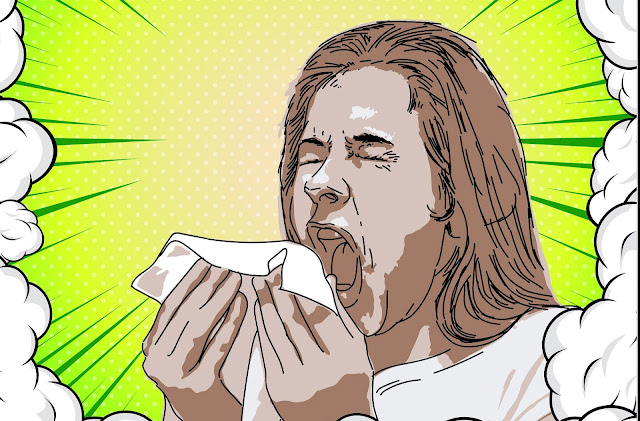
Drawing of a girl sneezing

Photo: Pixabay.com

Sneezing is a defense reaction against potentially harmful stimuli. Stopping the urge to sneeze is a bad idea for several reasons.

How to sneeze properly

The speed of a sneeze can easily match a hurricane. The suppression of sneezing can lead to increased pressure in the draining cerebral vein and thus in the head, similar to pressing. For this reason alone, suppressing sneezing is not recommended.

You should stop your nose when sneezing either. This builds up pressure and presses nasal secretions into the sinuses.

Until now, it was a good practice to hold your hand over your mouth when sneezing. But not only since the outbreak of the corona pandemic some say that this does more harm than good, since viruses spread quickly through the hands. 

Its recommended do sneeze in clean paper handkerchief held in front of your mouth, or the crook of the arm should only be used as the second option.


Popular posts from this blog

Folding step stool woodworking plan - Step by Step Guide

A Step-Ladder Stool is of just the right height for general household use, for washing woodwork, or for reaching upper shelves in the pantry. It also makes an excellent kitchen stool, the lower step serving the purpose of a foot-rest. When the ladder-stool is not in use, it may be folded into the compact form shown in Fig. 119, and stood behind a door or in some other out of the way place. The Ladder consists of three portions, the steps (Fig. 120), the rear legs (Fig. 125), and the seat or top step (Fig. 128). The Side Rails of the steps (A, Fig. 120) should be cut of the dimensions shown in Fig. 121. Mark the ends to be cut to the angle shown, the top to be notched to receive an end of the crosspiece D (Fig. 120). The diagram shows the positions for steps B and C. The steps must pitch at the same angle as the rail ends. Groove the side pieces to a depth of 3/8 inch, to receive the ends of the steps (Fig. 123). You will see by Fig. 120 that the sides of the grooves must ...

Morse Code for Kids and Morse Code Alphabet

In 1832, an American artist sailed home from Europe. He had spent some time painting in Europe and hoped to sell his pictures when he arrived home.  His name was  Samuel Morse. The journey on the ship was to change Samuel Morse’s life. Read more: How to make a morse code machine... He met a young chemist from Boston, named Charles Jackson, who showed him how an electromagnet works. Morse became interested in electricity and in the idea of sending messages along electric wires. Samuel Morse was one of the first people to make an electric telegraph.  An electric telegraph uses an electric current to send messages along a wire. - - - - - - - - - Read more about:  Why do wisdom teeth cause so many problems? - - - - - - - - - Operators of this electric telegraph machine sent messages down the line in Morse Code. Morse Code Alphabet This telegraph was not what made Morse famous. He gave his name to the code of dots and dashes which he invente...

Moro carrot soup - Natural Remedy for Diarrhea - Professor Ernst Moro Carrot Soup

In the early XXth century diarrhea was the cause of death for many babies in Germany and in the whole world.  Professor Ernst Moro (1874 - 1951) the head of the children's hospital in Heidelberg at that time, found out by experiment that a simple carrot soup decreased the death rate of babies suffering from diarrhea by nearly 50%. Ernst Moro in 1904 A German study published in 2002[1] outlines that acidic oligosaccharides formed in aqueous extracts from carrots (carrot soup) may lead to less adherence of bacterial agents to the mucosal wall of the bowel, thus being a more effective treatment for acute gastrointestinal infections of children than glucose-electrolyte-solution oral rehydration. In 2009, experiments showed that Professor Moro's Carrot Soup can cure diarrhea caused by bacteria that are resistant to antibiotics.[2] Even today the diarrhea is one of the main causes of death among children in developing countries. Many lives can be saved by using this simple recipe...