Sound Energy Definition - What Is Sound Energy?

Have you ever heard a jet airplane when it is getting ready to take off?
The noise that the plane makes is sometimes so loud that you cannot hear any other noise.

Sound is a type of energy.

Sounds are produced when an object vibrates.

When this happens, the air around the object also vibrates. These vibrations in the air travel as sound waves. A jet engine makes a great deal of sound energy. The engine sounds loud when it is close, but you can sometimes hear the noise when the plane is even several miles away from you.

People who work on airport runways need to protect their ears from the noise of the aircraft engines. They wear protective gear over their ears.

Rippling vibrations

Think of the ripples on a small lake when you throw a pebble into the calm water. If the lake is big enough, the ripples become smaller and smaller until they disappear altogether before they reach the edge of the lake.

In the same way, sound spreads out in waves from the place where it is first made.
The sound waves, like the ripples in the lake, become weaker the farther they travel.
The energy of the waves becomes more spread out.

Scientists use units called decibels to measure the intensity of sound.

The sound of whispering measures about 20 decibels.
The noise from a jumbo jet taking off at close range measures about 140 decibels.
If sound measures more than 140 decibels, it is dangerous and can seriously damage your hearing.
The sound of a purring cat is soft and gentle, but the noise made by a jumbo jet is loud and harsh.

WHAT IS POTENTIAL ENERGY?

“On your marks!
Get set!
Go! ”
These are the orders the starter shouts when you take part in a running race.
When you are running, your body has a lot of kinetic energy, the energy of movement. When you are “on your marks,” you use a small amount of energy. Most of your energy is stored, or saved up, ready for the running of the race.

Energy that is stored and waiting to be used is called potential energy.

Potential energy is often linked to work that has already been done. Take a ball and place it on the floor. Now put the ball on a high shelf. The ball has more potential energy when it is on the shelf than it has on the floor. The ball has gained this extra energy because work was done when the ball was placed on the high shelf. Do you know how to turn the potential, or stored, energy of the ball into kinetic, or moving, energy?

How is energy stored?

An archer’s bow has potential energy when it is bent. When the archer releases the bow, this potential energy changes into kinetic energy, and the arrow shoots forwards. When you wind up a clock, potential energy is stored in the clock’s spring. This energy changes into the kinetic energy that makes the clock work.

The potential energy of this archer’s bent bow will turn into kinetic energy when the archer releases the bow’s string.
http://www.smartkids123.com

HOW DO WE GET ENERGY FROM FOOD?

We use energy all the time, even when we are asleep.
We need energy for our body to work.
We need energy to keep us warm.
When the weather is cold, or when we take part in sports, we need extra amounts of energy to help our body and muscles work harder.
Our energy comes from the food we eat.
 Food contains chemical energy. As the food is broken down, our body uses the energy to keep warm and to do work.

Do you know which foods contain large amounts of chemical energy?

Scientists have been able to work out the amounts of chemical energy in different foods.
The amount of energy in food is measured in units called calories.
A plateful of lettuce, for example, has few calories and therefore very little energy.
Rice and bananas contain much more energy.
But an equal amount of ice cream contains even more!
When you eat food, it travels through your body to your stomach and intestines.
Special chemicals called enzymes in your stomach break down the food into different substances that your body can use. We call this breaking-down process digestion. The substances from food that produce energy for your body most efficiently are called fats and carbohydrates. Fats, like butter and oil, and carbohydrates, like bread, potatoes, and sugars, are high in calories.

Our body needs energy

Different people need different amounts of energy from their food. A person doing heavy work, like digging or sawing wood, or an Arctic explorer in the freezing cold needs a lot more energy than an office worker. Active children need about the same amount of energy as adults doing light work. Older people usually do less work and move around more slowly, so they need less energy.
It is important to eat only as much food as your body needs to keep your weight and energy at a comfortable level. It is also important to eat the right kinds of food. Besides fats and carbohydrates, your body also needs proteins such as fish, meat, and cheese. Protein is necessary for the growth and maintenance of body structures.

What is nuclear energy - for kids

In the center of every atom is the nucleus.  This is made of tiny particles called protons and neutrons. Protons have a positive electrical charge. Neutrons have no electrical charge.

What is nuclear energy - for kids
Atom

The nucleus is surrounded by electrons, which have a negative charge. The positively charged protons and negatively charged electrons attract each other. Each atom is held together by this force of attraction.

  Splitting of atoms

Most atoms can be arranged into different groups, to make different substances. The atoms of a few metals can be changed, or split, to make new, different atoms. The nucleus of an atom of metal called uranium can be split into two.

This is called nuclear fission. The word “fission” means breaking apart.

When the nucleus of a uranium atom is split, some of its neutrons escape. These neutrons crash into other uranium atoms, causing them to split. As the nucleus of the atom is split, it releases huge amounts of heat. In a nuclear power station, this heat energy is used to produce electricity.

Fusing atoms

The nuclei of the atoms of the gas hydrogen cannot be split, but they can be squeezed together.

This process is called nuclear fusion. The word “fusion” means joining together.

A type of hydrogen gas called deuterium is heated to extremely high temperatures. The deuterium atoms crash into each other and form heavier elements. This process releases large amounts of energy. Scientists are trying to find a way of using nuclear fusion in power stations because it will be one of the cheapest and cleanest ways of producing electricity.

The sun’s energy comes from the nuclear fusion of hydrogen atoms. The hydrogen atoms in the sun continually crash into each other and fuse, making larger atoms of helium gas.

An atom is made up of three different types of particles—protons, neutrons, and electrons. The protons and neutrons are crowded into the nucleus near the center of the atom. The electrons go around the nucleus at fantastic speeds.


The photograph shows the mushroom-shaped cloud that rises up into the air following a nuclear explosion.

WHAT IS CHEMICAL ENERGY - FOR KIDS?

Have you ever been to a display of chemical energy?
You probably have, but you called it something else. At a display of chemical energy, there are usually many different colored lights and a lot of noise.
Rockets shoot up into the sky.
Firecrackers make loud bangs.
Pinwheels spin around very quickly.
Stars shoot out of Roman candles.
Yes, fireworks use chemical energy. 
Fireworks are made of a special exploding powder called gunpowder, as well as other explosive chemicals. These chemicals contain lots of energy. When gunpowder burns, it releases large amounts of different gases. These gases are released at great speed. So the energy escapes quickly and with lots of noise into the air. The colored lights of the fireworks are made by burning other chemicals.

When a firework has finished burning, all that is left inside is some black powder which does not burn. The high-energy chemicals in the gunpowder have been changed into high-energy, moving gases.
These gases have created kinetic energy of motion and sound. The change that takes place inside the firework is called a chemical change.

Chemical change

Fireworks are just one example of a chemical change.
There are many more examples taking place all around you. Car engines use chemical energy, too. High-energy molecules of gasoline are burned inside a car engine. The gasoline molecules turn into gas molecules that produce kinetic energy.
Chemical energy can also be produced without burning. Animals and humans use chemical energy in food. They use the chemical energy to work and keep warm. Light energy from the sun can also be changed into chemical energy.
This happens when sunlight reaches the leaves of plants.
The plants trap this energy and use it to make a special substance called glucose. The glucose contains chemical energy. Living things can get energy from glucose.

Car engines run on a mixture of gasoline and air. When this mixture comes into contact with an electric spark, heat energy and kinetic energy are produced.

WHAT ARE RENEWABLE ENERGY SOURCES?

  • How do you keep cool in your house?

  • What sort of light do you use at night?

  • What appliances do you have in your home?

    Anything that gives you heat or light uses energy.

Household appliances use energy. In your notebook, make a list of all the things in your kitchen that use energy. What kind of energy do you think each appliance uses?
Most homes receive a supply of electricity. The electricity travels along cables and wires from a power station. At the power station, electricity is usually made from the energy released by burning fossil fuels, or by using nuclear fuel or waterpower.
Fossil fuels developed from the remains of prehistoric plants and animals. 
These fuels include coal, natural gas, and petroleum, from which we get oil. Wood, also, is often classified as a fossil fuel.
Besides electricity, fossil fuels are also used as a source of energy in our homes. Wood, coal, and oil can be burned to give heat. Natural gas can be burned for heating and cooking. Oil lamps and gasoline lanterns can be used as a source of light.
Other sources of energy in the home include solar energy and wind power.
Solar energy is energy from the sun, often gathered by solar panels. Solar energy can warm a house or heat up water. Wind power is often impractical unless there are strong, steady winds.

Fossil fuels are called nonrenewable sources

- of energy because, once they have been used up, they cannot be replaced. One day, all the coal, natural gas, and oil on earth may be used up. There will then be no more available.

Sources of energy that can be used over and over again are called renewable, or inexhaustible, sources.

Solar energy and forms of solar energy, like wind power and water power, are renewable energy sources. No matter how much we use them, there will always be plenty more.


Renewable and Nonrenewable Energy Resources

The world is full of movement.
Trees move in the wind.
Aircraft fly in the air.
Ships sail on the sea.
People and animals move around.
None of these things can move without energy. Living things and machines need energy in order to work.

Where does energy come from?

Almost all energy comes from the sun.
The sun’s energy changes into other kinds of energy when it reaches the earth.
The sun’s energy is even in coal and oil.
Long ago, the sun gave its energy to plants and animals. When they died, their bodies slowly turned into oil and coal over millions of years.
Power stations then change the energy in coal and oil into electrical energy.
Without the sun providing energy, there would be no life on earth.

Energy sources

How do you keep cool in your house? 
What sort of light do you use at night? 
What appliances do you have in your home? 
Anything that gives you heat or light uses energy. 
Household appliances use energy. In your notebook, make a list of all the things in your kitchen that use energy.
What kind of energy do you think each appliance uses?
Most homes receive a supply of electricity. The electricity travels along cables and wires from a power station. At the power station, electricity is usually made from the energy released by burning fossil fuels, or by using nuclear fuel or waterpower.
Fossil fuels developed from the remains of prehistoric plants and animals.
These fuels include coal, natural gas, and petroleum, from which we get oil.
Wood, also, is often classified as a fossil fuel.
Besides electricity, fossil fuels are also used as a source of energy in our homes.
Wood, coal, and oil can be burned to give heat. Natural gas can be burned for heating and cooking.
Oil lamps and gasoline lanterns can be used as a source of light.
Other sources of energy in the home include solar energy and wind power.

Solar energy is energy from the sun, often gathered by solar panels. Solar energy can warm a house or heat up water. Wind power is often impractical unless there are strong, steady winds.

Fossil fuels are called nonrenewable sources

- of energy because, once they have been used up, they cannot be replaced. One day, all the coal, natural gas, and oil on earth may be used up. There will then be no more available.

Sources of energy that can be used over and over again are called renewable, or inexhaustible, sources.

Solar energy and forms of solar energy, like wind power and water power, are renewable energy sources. No matter how much we use them, there will always be plenty more.

Who invented the airplane before the Wright brothers?

The thought of flying like a bird is among the oldest of human dreams. One of the most famous legends of the ancient Greeks, talks about Icarus, who glued wings with wax to himself and soared into the sky!
While he was flying toward the sun, the wax melted, and Icarus plunged into the sea and drowned. Icarus has become a symbol of man's aspirations to reach the celestial nowhere.
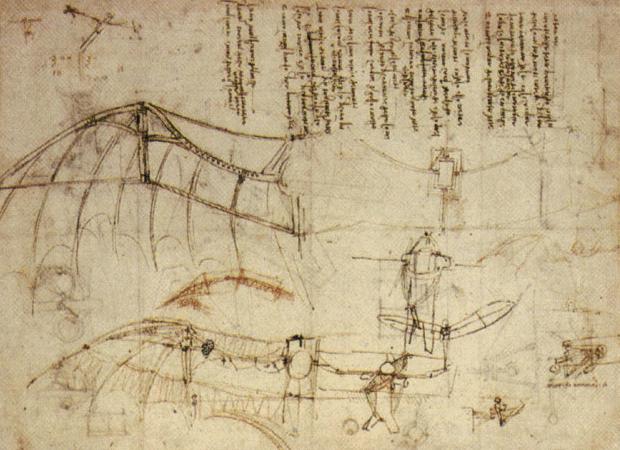
Leonardo Da Vinci, one of the greatest artists of the Renaissance, drew sketches for some kind of flying machine that will run on manpower. Also many other artists and dreamers, hundreds of years ago dreamed of flying “like a bird”.

Leonardo Da Vinci - sketches for flying machine


The oldest aircraft did not have anything that would move. These, in fact, resembled more like huge dragons or boats, and during the 19th century, numerous experiments were conducted.

But then no one has managed to invent a machine heavier than air, which would have its own drive.
Some, indeed, even doubted that such a machine is even possible to make.

The first man who proved that it is indeed possible was Professor Samuel Langley, from the Smithsonian Institution in Washington. He made two machines 4.5 meters long and 3.5 meters wide, which were powered by steam engines from one and a half horsepower. 
In 1896 these two models successfully flew but in 1903, during a test flight, one machine crashed on October 7th, 1903.
Soon after on December 17, 1903, the American brothers Orville and Wilbur Wright were able to successfully fly for the first time in a machine heavier than air, which had its own motive power.
In Kitty Hawk, in North Carolina, they made a flight of 36 meters for 12 seconds, and when the second flight of 260 meters for 59 seconds.

Thus the plane was born.


WHO INVENTED THE PARACHUTE?

Imagine if you find yourself into an empty space at the height of 4-5 miles above the Earth, and yet you have landed on the ground as if you jumped from fence 3 meters high.
This we can do with a parachute!

The parachute is just a big umbrella, that with its shape and surface, due to air resistance, slows the decline and fall of man through the air, slowly and slowly enough, that he does not hurt himself when he hits the ground.
The parachute is probably the oldest invention of slowing the fall.
Leonardo Da Vinci made a sketch of a parachute in his notebook in 1514.
Faust Vrančić published in 1595 a description of a usable parachute.
It is believed that the first man who used a parachute was the Frenchman Blanchard. In 1785 from a flying air balloon he parachuted a dog in a basket.
Jean-Pierre Blanchard claimed that he also parachuted from a balloon in 1793 and that during the descent to Earth, he broke his leg.

Another Frenchman, André-Jacques Garnerin, became famous as the first man who regularly paratrooped. For first time he publicly performed in Paris on October 22nd, 1793, and this is when he successfully jumped from a height greater than 600 meters.His parachute had a shape of umbrellas and was made of white cloth which was used for making sails, with diameter of 7 meters. At the center of the dome was a wooden reel of about 25 centimeters, with a hole in the middle, which allowed the air to come out from the dome.
The first successful parachute jump from an airplane in flight was performed in 1912 by the Captain Berry in Saint Louis, Missouri. 
During 1913 and 1914 there were many discussions if whether to use the parachutes to rescue the pilots from the plane. At the moment when the First World War started, this question has not yet been clarified. There was a problem in determining the size of the parachute, and in addition there was a fear that the pilot will not be able to jump out of a plane, without entangling the parachute.
In 1919 the U.S. military has embraced the seat type parachute as part of compulsory aviation equipment.

History of Helicopters - Who Made the First Helicopter?

People for long time have dreamed of a flying machine that could rise from the ground right up. Leonardo Da Vinci around year 1500, made a drawing of giant helicopter, which looked like a screw.
Leonardo never attempted to make this helicopter, because he had no engine.

In France in 1783 a toy helicopter was presented, named "Chinese tern", although no one knew
from where this device actually originated. In 1796 George Kelly experimented with similar Chinese terns, and gave a blueprint for steam helicopter.

Over the next hundred years, many have tried to construct a helicopter. Some of these projects were fantastic, others almost practically feasible, but only a few helicopters took off.
The problem was the lack of powerful engine that could lift the helicopter. During the First World War, when such engines were made, it has become possible to construct helicopters that were able to loft a man above the ground.
Designer Igor Sikorsky made two helicopters in 1909th and 1910th. Toward the end of 1917, two Austro-Hungarian officers constructed a helicopter designed for observation of the front, a task that was previously carried out by air balloons. This helicopter was able to repeatedly lift up to greater heights, but in all ended there.
Work on the construction of the helicopter continued in many countries, but without any major success. However in 1936 news came from Germany that the company “Focke-Wulf” managed to produce a good helicopter. This helicopter in 1937 managed to fly long distances at speeds of around 110 kilometers per hour and at altitudes greater than 3,300 meters.

In year 1940 the designer Igor Sikorsky demonstrated his helicopter which could be used in the practice, which was supplied to the U.S. Army in 1942.